
Search
Did you mean: Medea?
Remove Ads
Advertisement
Search Results

Definition
Ashurbanipal
Ashurbanipal (r. 668-627 BCE, also known as Assurbanipal) was the last of the great kings of Assyria. His name means "the god Ashur is creator of an heir" and he was the son of King Esarhaddon of the Neo-Assyrian Empire. In the Hebrew...

Definition
Archimedes
Archimedes (l. 287-212 BCE) was a Greek engineer and inventor who is regarded as the greatest mathematician of antiquity and one the greatest of all time. He is credited with a number of inventions still in use today (such as the...

Definition
Hephaistos
Hephaistos (Hephaestus) was the ancient Greek god of fire, metallurgy, and crafts. He was the brilliant blacksmith of the Olympian gods, for whom he fashioned magnificent houses, armour, and ingenious devices. Hephaistos had his workshop...

Definition
Buddhism
Buddhism is a non-theistic religion (no belief in a creator god), also considered a philosophy and a moral discipline, originating in the region of modern-day India in the 6th and 5th centuries BCE. It was founded by the sage Siddhartha...

Definition
Confucius
Confucius (Kongzi) was a 6th century BCE Chinese philosopher. His thoughts, expressed in the philosophy of Confucianism, have influenced Chinese culture right up to the present day. Confucius is a larger than life figure and it is...

Definition
Greek Philosophy
Ancient Greek philosophy is a system of thought, first developed in the 6th century BCE, which was informed by a focus on the First Cause of observable phenomena. Prior to the development of this system by Thales of Miletus (l...

Definition
Castor and Pollux
Castor and Pollux (the Dioscuri) are figures from Greek and Roman mythology considered the twin sons of Zeus or Jupiter. Semi-divine figures, the twins were credited with the role of saving those in trouble at sea or in grave...

Definition
Byzantine Art
Byzantine art (4th - 15th century CE) is generally characterised by a move away from the naturalism of the Classical tradition towards the more abstract and universal, there is a definite preference for two-dimensional representations...

Definition
Athanaric
Athanaric (died c. 381 CE) was a king of the Thervingi Goths (better known as the Visigoths) and, according to some sources, the first and greatest king. He was of the noble Balts family of the Thervingi tribe and a relative of the...
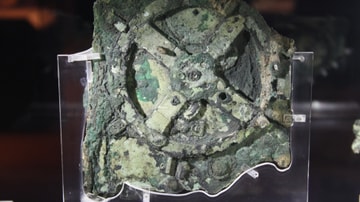
Definition
Antikythera Mechanism
The Antikythera mechanism (also known as the Antikythera Device), dated to the late 2nd century/early 1st century BCE (roughly 205-60 BCE) is understood as the world's first analog computer, created to accurately calculate...
