
Search
Remove Ads
Advertisement
Search Results

Definition
Ninurta
Ninurta (identified with Ningirsu, Pabilsag, and the biblical Nimrod) is the Sumerian and Akkadian hero-god of war, hunting, and the south wind. He first appears in texts in the early 3rd millennium BCE as an agricultural god and local deity...

Definition
Sumer - The Cradle of Civilization
Sumer was the southernmost region of ancient Mesopotamia (modern-day southern Iraq and parts of Kuwait), which has long been considered the cradle of civilization. The name comes from Akkadian, the language of the north of Mesopotamia, and...
Definition
Nehushtan
According to the Bible, Nehushtan was a metal serpent mounted on a staff that Moses had made, by God's command, to cure the Israelites of snake bites while wandering in the desert. The symbol of snakes on a staff or pole is a motif that is...

Image
Copper alloy foundation figurines with pegs representing Gods
Each peg has a very faint cuneiform inscription of Gudea, the ruler of the city-state of Lagash. Foundation pegs were buried in the foundation of buildings to magically protect them and preserve the builder's name for posterity. In this...
Image
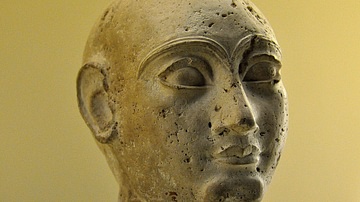
Limestone Head of a Man
Limestone head of a statue, probably Gudea, ruler of Lagash. The rest of the body is missing. Probably from Tell Telloh (ancient Girsu), southern Mesopotamia, Iraq. 2144-2124 BCE. (The Pergamon Museum, Berlin).

Image
Foundation Pegs, from Ningirsu Temple, Girsu
Each peg has a very faint cuneiform inscription of Gudea, the ruler of the city-state of Lagash. Foundation pegs were buried in the foundation of buildings to magically protect them and preserve the builder's name for posterity. In this...
Image
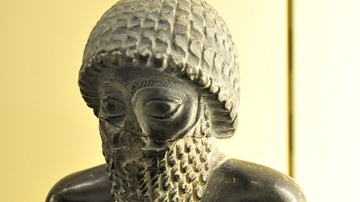
Statue of Ur-ningirsu
The cuneiform inscriptions on the back of this small diorite statue (height 18 cm) read, "Dedicated to the god Ningizzida, his god, by Ur-ningirsu, priest-prince of Lagash, son of Gudea, priest-prince of Lagash." This bearded man is Ur-ningirsu...

Definition
Mesopotamian Art and Architecture - The Birth of Art and Architecture in the Ancient World
Ancient Mesopotamian art and architectural works are among the oldest in the world, dating back over 7,000 years. The works first appear in northern Mesopotamia prior to the Ubaid period (circa 6500-4000 BCE) and then developed in the south...

Definition
Nisaba
Nisaba (also Naga, Se-Naga, Nissaba, Nidaba, and associated with Nanibgal) is the Sumerian goddess of writing, accounts, and scribe of the gods. Although her name is commonly given as Nidaba, noted scholar Jeremy Black points out that "the...

Definition
Sumerian Language
The Sumerian language was spoken in southern Mesopotamia before the 2nd millennium BCE and was the first language to be written in the cuneiform script. It is an isolate language meaning we know of no other languages that relate to it ancestrally...
