
Search
Remove Ads
Advertisement
Search Results

Definition
Uruk - The First Great City
Uruk was one of the most important cities (at one time, the most important) in ancient Mesopotamia. According to the Sumerian King List, it was founded by King Enmerkar circa 5000/4500 BCE. Uruk is best known as the birthplace of writing...

Definition
Sargon of Akkad - From Gardener to King of the Four Corners of the World
Sargon of Akkad (reign 2334-2279 BCE) was the king of the Akkadian Empire of Mesopotamia, the first multinational empire in history, who united the disparate kingdoms of the region under a central authority. He is equally famous today as...

Definition
Ancient Persian Warfare
The ancient Persian military evolved from the earlier armed forces of the Medes which, in turn, developed from the warrior class of the indigenous people of the Iranian Plateau, the Aryan migrants (including the Persians) who later settled...
Definition
Mari
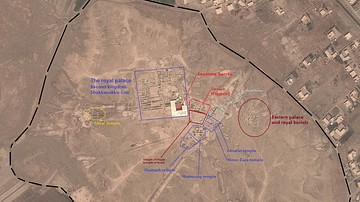
Mari was a city-state located near the west bank of the Euphrates River in Northern Mesopotamia (now eastern Syria) during the Early Bronze Age and the Middle Bronze Age. One of the earliest known planned cities, Mari is believed to have...
Definition
Enlil
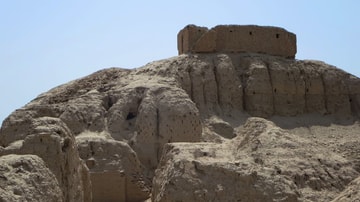
Enlil (also known as Ellil and Nunamnir) was the Sumerian god of the air in the Mesopotamian Pantheon but was more powerful than any other elemental deities and eventually was worshiped as King of the Gods. He is featured in a number of important...

Definition
Nergal
Nergal (also known as Erra and Irra) is the Mesopotamian god of death, war, and destruction. He began as a regional, probably agricultural, god of the Babylonian city of Kutha in the Early Dynastic Period I (c. 2900-2800 BCE). As his temple...

Definition
Gula
Gula (also known as Ninkarrak) is the Sumerian goddess of healing and patroness of doctors, healing arts, and medical practices. She is first attested to in the Ur III Period (2047-1750 BCE) where she is referenced as a great goddess of health...

Image
Inscribed Giant River-worn Pebble
The cuneiform inscriptions mention that Enannatum, king of Lagash, reminds the gods of his prolific temple building achievements in the city of Lagash. From Girsu (modern-day Tell Telloh, Dhi-Qar Governorate, Iraq), Mesopotamia. Early dynastic...

Image
Babylon at the time of Hammurabi
A locator map of Hammurabi's Babylonia, showing the Babylonian territory upon his ascension in 1792 BC and upon his death in 1750 BC. The river courses and coastline are those of that time period — in general, they are not the modern rivers...

Article
Trade in Ancient Mesopotamia - How Commerce Encouraged Civilization
Local trade in ancient Mesopotamia began in the Ubaid period (circa 6500-4000 BCE), had developed into long-distance trade by the Uruk period (circa 4000-3100 BCE), and was flourishing by the time of the Early Dynastic period in Mesopotamia...
