
Search
Remove Ads
Advertisement
Search Results

Definition
Vidar
Vidar is a figure in Norse mythology, described as the silent god and almost as mighty as Thor. He will survive Ragnarök, the unavoidable and dramatic end of the world according to the prophecy that chief-god Odin extracts from a seeress...

Definition
Valhalla
Valhalla ("Hall of the Slain") is the afterlife realm in Norse mythology for fallen heroes selected by Odin’s Valkyrie to become members of the army that will fight against the forces of chaos at Ragnarök. The concept of Odin’s Hall...

Article
Viking Prophecy: The Poem Völuspá of the Poetic Edda
The Völuspá (Old Norse: Vǫluspá) is a medieval poem of the Poetic Edda that describes how the world might have come into shape and would end according to Norse mythology. The story of about 60 stanzas...
Image
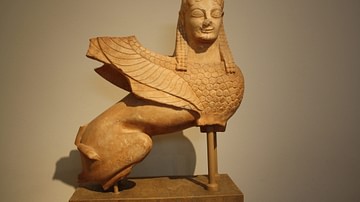
Greek Funerary Sphinx
A sphinx in pentelic marble, from a funerary stele, c. 570 BCE.
National Archaeological Museum, Athens.

Image
Greek Trireme Model
A model of a trireme from ancient Greece. (Archaeological Museum, Hania, Crete)

Image
Greek Chariot
A depiction of a chariot with charioteer on an attic black-figure kylix (510-500 BCE). Olympia Archaeological Museum.
Image
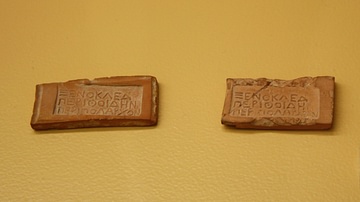
Greek Clay Passport Tokens
Clay tokens probably used as passports by travellers or messengers reporting between military headquarters. Belonging to Xenokles, a border commander, 4th century BCE. (Agora Museum, Athens)

Image
Greek Foot Race
Attic black-figure column crater depicting a foot race (510-500 BCE). Olympia Archaeological Museum.
Image
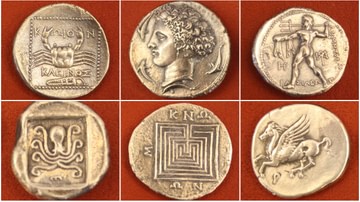
Greek Coins
Top row (L to R): Cos (300-190 BCE) Silver tetradrachm, crab. Syracuse (c. 400 BCE) - Silver decadrachm, head of Arethousa with dolphins. Macedon (306-283 BCE) - Silver tetradrachm, Poseidon with trident. Bottom row (L to...
Image
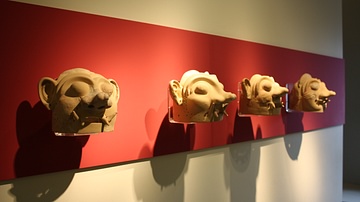
Greek Terracotta Masks
Terracotta ceremonial masks from Tiryns, 7th century BCE. Nafplio Archeaological Museum.
