
Search
Remove Ads
Advertisement
Search Results

Definition
Ares
Ares was the Greek god of war. He was perhaps the most unpopular of all the Olympian gods because of his quick temper, aggressiveness, and unquenchable thirst for conflict. Ares famously seduced Aphrodite, unsuccessfully fought with Hercules...

Image
The Twelve Elder Titans in Greek Mythology - according to Theogony (Generations of the Gods) by Hesiod
In early Greek cosmology, the Twelve Elder Titans were the children of the primordial deities Gaia (Earth) and Ouranos (Sky), representing an older divine order...

Definition
Hebe
Hebe (meaning "youth" or "bloom of youth") is the goddess and personification of eternal youth in Greek mythology. She is the daughter of Zeus and Hera and the wife of the Greek hero Hercules. Hebe serves as the cupbearer for the gods...

Article
Hipparchia the Cynic: Devoted Wife, Mother, & Outspoken Greek Philosopher
Cynic philosopher, wife of Crates of Thebes (l. c. 360 – 280 BCE), and mother of his children, Hipparchia of Maroneia (l. c. 350 – 280 BCE) defied social norms in order to live her...

Definition
Vikings
The Vikings were originally diverse Scandinavian seafarers from Norway, Sweden, and Denmark (though other nationalities were later involved) whose raids and subsequent settlements significantly impacted the cultures of Europe and were...

Definition
Battle of Salamis
The Battle of Salamis was a naval battle between Greek and Persian forces in the Saronic Gulf, Greece in September 480 BCE. The Greeks had recently lost the Battle of Thermopylae and drawn the naval Battle at Artemision, both...

Definition
Nyx
Nyx (also known as Nox or the Night) is the personification of the night in Greek mythology. Coming from Chaos (Void), Nyx is a primordial deity (Protogenoi). The Protogenoi represent the physical and elemental forces of the world and consist...

Definition
Baal
Baal (also given as Ba'al) is a Canaanite-Phoenician god of fertility and weather, specifically rainstorms. The name was also used as a title, however, meaning "Lord" and was applied to a number of different deities throughout the ancient...
Definition
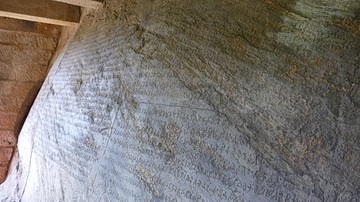
The Edicts of Ashoka the Great
The Edicts of Ashoka are 33 inscriptions engraved on pillars, large stones, and cave walls by Ashoka the Great (r. 268-232 BCE), the third king of the Mauryan Empire (322-185 BCE) of India. One set, the so-called Major...

Definition
Etruscan Religion
The religion of the Etruscans, the civilization which flourished from the 8th to 3rd century BCE in central Italy, has, like many other features of the culture, long been overshadowed by that of its Greek contemporaries and Roman...
