
Search
Remove Ads
Advertisement
Search Results

Definition
Harper's Songs of Ancient Egypt
Harper's songs were lyrics composed in ancient Egypt to be sung at funeral feasts and inscribed on monuments. They derive their name from the image which accompanies the text on tomb or chapel walls, stelae, and papyri...

Definition
Second Intermediate Period of Egypt - The Era of the Hyksos
The Second Intermediate Period (circa 1782 to circa 1570 BCE) is the era following the Middle Kingdom of Egypt (2040-1782 BCE) and preceding the New Kingdom (circa 1570-1069 BCE). As with all...

Definition
Fayum
The Faiyum (also given as Fayoum, Fayum, and Faiyum Oasis) was a region of ancient Egypt known for its fertility and the abundance of plant and animal life. Located 62 miles (100 kilometers) south of Memphis (modern Cairo), the Faiyum...

Definition
Karnak
Karnak is the modern-day name for the ancient site of the Temple of Amun at Thebes, Egypt. The Egyptians called the site Nesut-Towi, "Throne of the Two Lands", Ipet-Iset, "The Finest of Seats" as well as Ipt-Swt, "Selected Spot" also...
Article
Weapons in Ancient Egypt
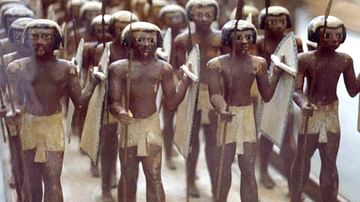
The ancient Egyptian military is often imagined in modern films and other media as a heavily armed and disciplined fighting force equipped with powerful weapons. This depiction, however, is only true of the Egyptian army...

Article
Interrelations of Kerma and Pharaonic Egypt
The vacillating nature of Ancient Egypt's associations with the Kingdom of Kerma may be described as one of expansion and contraction; a virtual tug-of-war between rival cultures. Structural changes in Egypt's...

Definition
Eucratid
The Eucratids were a Greco-Bactrian and Indo-Greek dynasty of approximately 12 kings, lasting between c.171 BC and 80-70 BC, according to numismatic evidence. The numismatic emblem which characterized it were the palm and the Dioscuri...

Definition
The Hittites
The Hittites occupied the ancient region of Anatolia (also known as Asia Minor, modern-day Turkey) prior to 1700 BCE, developed a culture apparently from the indigenous Hatti (and possibly the Hurrian) people, and expanded their...

Image
Map of the Ptolemaic Kingdom of Egypt c. 240 BCE - Power, Wealth, and Rivalry in the Hellenistic World
By c. 240 BCE, Ptolemaic Egypt stood as one of the most powerful and stable successor states of Alexander’s empire, reaching a high point under Ptolemy III Euergetes...

Image
The Sovereign Rulers of the Kingdom of Jerusalem (1099–1228) - Dynasty, Crusade, and Kingship in the Latin East
The Kingdom of Jerusalem (1099–1291) emerged in the aftermath of the First Crusade (1096–1099) and became the most prestigious of the Crusader states...
