
Search
Remove Ads
Advertisement
Search Results

Definition
Druid
Druids were a class of individuals in ancient Celtic cultures known for their great wisdom and knowledge of traditions. Not only priests who managed all religious rituals such as sacrifices (including humans), druids were able to give...

Definition
Phoenician Art
The art of the ancient Phoenicians, which flourished between the 19th and 4th centuries BCE, was exported throughout Mesopotamia and the ancient Mediterranean. Best known for their work on small decorative objects, Phoenician artists...

Definition
Spanish Galleon
The Spanish galleon (Spanish: galeón, nao, or navío) was a particularly large type of galleon used for both carrying cargo and as a warship armed with up to 60 cannons. Used from the mid-16th century until the early 19th century...

Definition
Sardis
Sardis (near modern-day Sart, Turkey) was the capital of the ancient Kingdom of Lydia founded (according to Herodotus) by the Heracleidae, the Heraclid Dynasty descended from the hero Heracles (Hercules). The city was famous in antiquity...
Definition
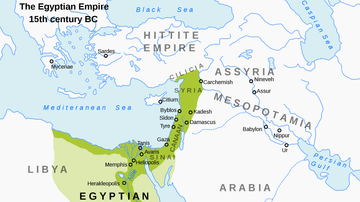
Egyptian Empire
The Egyptian Empire rose during the period of the New Kingdom (c. 1570- c. 1069 BCE), when the country reached its height of wealth, international prestige, and military might. The empire stretched from modern-day Syria in the...

Definition
Shahnameh
The Shahnameh (“Book of Kings”, composed 977-1010 CE) is a medieval epic written by the poet Abolqasem Ferdowsi (l. c. 940-1020 CE) in order to preserve the myths, legends, history, language, and culture of ancient Persia. It is the...

Definition
Thracian Art
The art produced by the people of Thrace, as indicated by the many precious objects found in Thracian tombs dating from the Bronze Age onwards, was, like the culture itself, a mix of indigenous ideas and foreign influences. Although...

Definition
Kingdom of Saba
Saba (also given as Sheba) was a kingdom in southern Arabia (region of modern-day Yemen) which flourished between the 8th century BCE and 275 CE when it was conquered by the neighboring Himyarites. Although these are the most...
Image
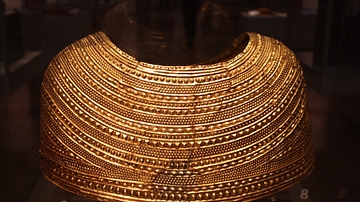
Mold Cape
The golden Mold Cape was discovered in the town of Mold in Flintshire, Wales in 1833 CE. The cape dates from 1900-1600 BCE, and is the only Bronze Age gold cape known to exist. The meaning behind the intricate patterns and designs...

Article
Causes of the Boer War
The causes of the Boer War (aka Second Anglo-Boer War, South Africa War, and Second War of Freedom, 1899-1902) stretched back to the early 19th century and competition for land and resources between British and Boer settlers...
