
Search
Remove Ads
Advertisement
Search Results
Definition
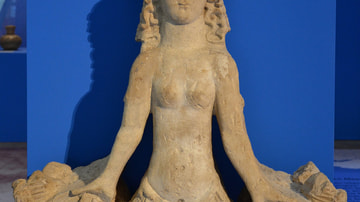
Scythian Religion
Scythian religion appears to be an amalgam of belief in a pantheon of gods grafted to more ancient animal reverence and shamanistic practice. According to their burial finds, the Scythians appear to have had a deep affinity with...

Definition
Diego Velázquez de Cuéllar
Diego Velázquez de Cuéllar (also spelt Velásquez, 1465-1524) was a Spanish conquistador who conquered Cuba in 1511, became the island's first governor for the next decade, and sponsored expeditions of conquest directed...

Definition
Juan de Grijalva
Juan de Grijalva (aka Grijalba, 1489-1527) was a Spanish conquistador who explored the eastern coast of Mexico in 1518. His notable achievements included a demonstration that the Yucatán Peninsula was just that and not, as previously...

Definition
Timbuktu - West Africa's Great Trading Centre
Timbuktu (Timbuctoo) is a city in Mali, West Africa which was an important trade centre of the Mali Empire which flourished between the 13th and 15th centuries. The city, founded c. 1100, gained wealth from...

Definition
Lorenzo Ghiberti
Lorenzo Ghiberti (1378-1455 CE) was an Italian Renaissance sculptor and goldsmith whose most famous work is the gilded bronze doors of the Baptistery of Florence's cathedral. These doors, which took 27 years to complete, were...

Definition
Tarentum
Tarentum (Taras, modern Taranto), located on the southern coast of Apulia, Italy, was a Greek and then Roman city. Controlling a large area of Magna Graecia and heading the Italiote League, Tarentum, with its excellent harbour, was...

Definition
Byzantine Art
Byzantine art (4th - 15th century CE) is generally characterised by a move away from the naturalism of the Classical tradition towards the more abstract and universal, there is a definite preference for two-dimensional representations...

Definition
Parthenon - Temple of Athena Parthenos
The magnificent temple on the Acropolis of Athens, known as the Parthenon, was built between 447 and 432 BCE in the Age of Pericles, and it was dedicated to the city's patron deity Athena Parthenos. The temple...
Definition
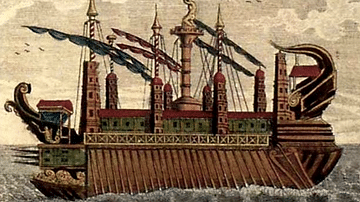
Syracusia
The Syracusia was an ancient sailing vessel designed by Archimedes in the 3rd century BCE. She was fabled as being one of the largest ships ever built in antiquity and as having a sumptuous decor of exotic woods and marble along with...

Definition
Michelangelo
Michelangelo (1475-1564 CE) was an Italian artist, architect and poet, who is considered one of the greatest and most influential of all Renaissance figures. His most celebrated works, from a breathtaking portfolio of masterpieces...
