
Search
Did you mean: Germanicus?
Remove Ads
Advertisement
Search Results

Article
Scandinavia Before the Vikings
In the Merovingian period, Scandinavia was only just emerging from its prehistoric Iron Age. A process of political centralization that had begun in the Migration Period led to the emergence of the first Scandinavian...

Image
Map of the Kingdom of the Vandals (435–534 CE)
The Kingdom of the Vandals and Alans (435–534 CE) emerged as one of the most significant post-Roman states in the western Mediterranean. Founded after the Vandals, a Germanic people originally from Central...

Definition
Thirty Years' War
The Thirty Years’ War (1618-1648) was the last major European conflict informed by religious divisions and one of the most devastating in European history resulting in a death toll of approximately 8 million. Beginning as a local...

Definition
Marcus Aurelius
Marcus Aurelius (r. 161 to 180 CE) was a Roman emperor best known as the last of the Five Good Emperors of Rome (following Nerva, Trajan, Hadrian, and Antoninus Pius) and as the author of the philosophical work Meditations. Although...

Definition
French Wars of Religion
The French Wars of Religion (1562-1598) were a series of eight conflicts between Protestant and Catholic factions in France lasting 36 years and concluding with the Protestant King Henry IV of France (r. 1589-1610) converting...

Definition
Investiture Controversy
The Investiture Controversy, also referred to as the Investiture Contest or Investiture Dispute, was a conflict lasting from 1076 to 1122 between the papacy of the Catholic Church and the Salian Dynasty of German monarchs...

Definition
Clovis I
Clovis I (or Chlodovech, 466-511/513 CE), king of the Franks, is considered the founding father of the Merovingian Dynasty, which would continue for over 200 years. Clovis became king at the age of 15, and by the time of his death 30...

Definition
Agora
The term agora (pronounced ah-go-RAH) is Greek for 'open place of assembly' and, early in the history of Greece, designated the area in a city where free-born citizens could gather to hear civic announcements, muster for military campaigns...

Definition
Melusine
Melusine (pronounced Mel-ew-seen, also given as Melusina) is a legendary figure from European folklore depicted as a mermaid, sometimes with two tails, as a serpent from the waist down, or as a dragon. She is associated with the ruling...
Definition
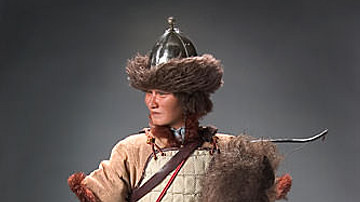
Attila the Hun
Attila the Hun (r. 434-453 CE) was the leader of the ancient nomadic people known as the Huns and ruler of the Hunnic Empire, which he established. His name means "Little Father" and, according to some historians, may not have...
