
Search
Did you mean: Germanicus?
Remove Ads
Advertisement
Search Results

Definition
Roman Empire
The Roman Empire, at its height (c. 117), was the most extensive political and social structure in western civilization. Building upon the foundation laid by the Roman Republic, the empire became the largest and most powerful political...

Definition
Vikings
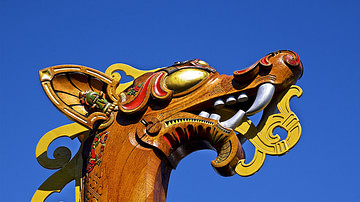
The Vikings were originally diverse Scandinavian seafarers from Norway, Sweden, and Denmark (though other nationalities were later involved) whose raids and subsequent settlements significantly impacted the cultures of Europe and were...
Definition
Beowulf
Beowulf is an epic poem composed in Old English consisting of 3,182 lines. It is written in the alliterative verse style, which is common for Old English poetry as well as works written in languages such as Old High German, Old Saxon...

Definition
German Peasants' War
The German Peasants' War (1524-1525) was a conflict between the lower class of the Germanic region of the Holy Roman Empire and the nobility over the feudal system of serfdom, religious freedom, and economic disparity. It...

Definition
Loki
Loki is a god in Norse mythology who is often simply described as the 'trickster' god for his love of playing pranks on both his fellow gods and his or their opponents. Sworn brother of Odin and often the one to dig the other gods out...

Definition
Nuremberg Laws
The Nuremberg Laws of September 1935 were a set of racial laws which set out a number of restrictions on Jewish people such as depriving them of the right to German citizenship and right to marry non-Jews. Amendments to the laws...

Definition
Edda
Edda is a term used to describe two Icelandic manuscripts that were copied down and compiled in the 13th century CE. Together they are the main sources of Norse mythology and skaldic poetry that relate the religion, cosmogony, and history...
Definition
Alemanni
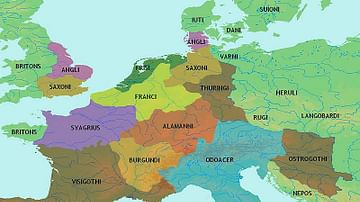
The Alemanni (also known as the Alamanni and the Alamans, meaning "All Men" or "Men United") were a confederacy of Germanic-speaking people who occupied the regions south of the Main and east of the Rhine rivers in present-day Germany...

Definition
Brunhilda of Austrasia
Brunhilda of Austrasia (c. 543-613) was a Visigothic princess who married into the Merovingian dynasty of the Franks, becoming the queen consort of the eastern kingdom of Austrasia. Following the brutal death of her sister...

Definition
Baldr
Baldr is a god in Norse mythology associated with light, wisdom, and courage, although he is never specifically defined as the god of any of these. He is best known for his dramatic death, which heralds the coming of Ragnarök, the end...
