
Search
Did you mean: Germanicus?
Remove Ads
Advertisement
Search Results

Definition
Indo-European Languages
The Indo-European languages are a family of related languages that today are widely spoken in the Americas, Europe, and also Western and Southern Asia. Just as languages such as Spanish, French, Portuguese and Italian are...
Definition
Runes
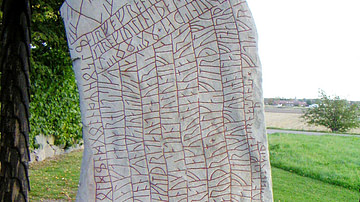
Runes are letters in the runic alphabets of Germanic-speaking peoples, written and read most prominently from at least c. 160 CE onwards in Scandinavia in the Elder Futhark script (until c. 700 CE) and the Younger Futhark - which illuminated...

Definition
Franks
The Franks were a Germanic people who originated along the lower Rhine River. They moved into Gaul during the Migration Age, where they established one of the largest and most powerful kingdoms in Europe after the fall of the Western...

Definition
The Goths
The Goths were a Germanic tribe who are frequently referenced for their part in the fall of the Roman Empire and their subsequent rise to power in the region of northern Europe, initially in Italy. Prior to their contact with Rome...

Definition
Lebensraum - The Nazi Ideal of Living Space in the East
Lebensraum ('living space'), is a geopolitical concept which was adopted by Adolf Hitler (1889-1945), the leader of Nazi Germany, to justify the military domination of Central and Eastern Europe...

Definition
The Saxons
The Saxons were a Germanic people of the region north of the Elbe River stretching from Holstein (in modern-day Germany) to the North Sea. The Saxons who migrated to Britain in the 5th and 6th centuries CE along with the Angles, Frisians...

Definition
Odin
Odin (Old Norse: Óðinn) is the main god in Norse mythology. Described as an immensely wise, one-eyed old man, Odin has by far the most varied characteristics of any of the gods and is not only the deity to call upon when war was being...

Definition
Walpurgis Night
Walpurgis Night (30 April, annually) is a modern-day European and Scandinavian festival derived from the merging of the ancient pagan celebration of Beltane with the commemoration of the canonization of the Christian Saint Walpurga...

Definition
Cimbri
The Cimbri were a tribe who lived in northern Jutland during the Roman era. Their ethnicity is enigmatic; scholars generally believe that the Cimbri were Germans, though others maintain that they were Celts. The late 2nd-century BCE migration...

Definition
Arminius
The Cherusci noble Arminius (c. 18 BCE - 19 CE) led the resistance to Roman conquest of Germania during the years 9-16 CE. Likely raised as a child hostage in Rome, Arminius gained command of a German auxiliary cohort in the Roman army...
