
Search
Remove Ads
Advertisement
Search Results
Definition
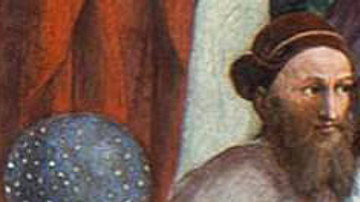
Hipparchus of Nicea - Greatest Astronomer of His Time
Hipparchus of Nicea (l. c. 190 - c. 120 BCE) was a Greek astronomer, geographer, and mathematician regarded as the greatest astronomer of antiquity and one of the greatest of all time. He is best known for his discovery of the precession...

Interview
Interview: Rome Strategy of Empire by James Lacey
In this interview, World History Encyclopedia sits down with author James Lacey to chat about his new book Rome: Strategy of Empire published by Oxford University Press. Kelly: Can you tell us a little bit about your background? James...

Definition
Leo Africanus
Leo Africanus (al-Hasan ibn Muhammad ibn Ahmad al-Wazzan al-Fasi al-Granati, 1485-1554) was a diplomat, merchant traveller and scholar who famously voyaged from Timbuktu to the Niger River and wrote 'The Description of Africa' (La Descrittione...

Definition
Juba II
Juba II (c. 48 BCE - 23 CE) was a Numidian prince and the king of Mauretania from c. 25 BCE until his death in 23 CE. He was raised in the household of Julius Caesar (c. 100-44 BCE) and married Cleopatra Selene II (40 - c. 17/5 BCE), the...

Image Gallery
A Gallery of Historical Maps
This gallery of 30 maps traces the history of cartography, with examples of maps made by cultures from the Paleolithic to the early modern period. The maps cover cities, states, continents, sometimes the entire world as it was known at the...

Definition
Ibn Battuta
Ibn Battuta (l. 1304-1368/69) was a Moroccan explorer from Tangier whose expeditions took him further than any other traveler of his time and resulted in his famous work, The Rihla of Ibn Battuta. Scholar Douglas Bullis notes that “rihla”...

Article
Food & Agriculture in Ancient Japan
The diet of ancient Japan was heavily influenced by its geography as an archipelago, foodstuffs and eating habits imported from mainland Asia, religious beliefs, and an appreciation for the aesthetic appearance of dishes, not just the taste...

Image
Eratosthenes' Calculation of the Earth's Circumference
An illustration showing Greek scientist Eratosthenes' method for calculating the circumference of the Earth. By measuring the angle of a shadow in one location (Alexandria) and comparing at the same time with a second point (Syene) where...
Image
Hipparchus of Nicea by Raphael
A detail from Raphael's 'The School of Athens' (c. 1509 CE) showing Greek astronomer, mathematician and geographer Hipparchus of Nicea (c. 190-120 BCE).

Book Review
Ancient Mesopotamian Government and Geography (Spotlight on the Rise and Fall of Ancient Civilizations)
In Ancient Mesopotamian Government and Geography, Laura la Bella attempts to offer a broad overview of ancient Mesopotamian government. Though, it is more an overview of Mesopotamian culture and practices that is framed by a distinction between...
