
Search
Remove Ads
Advertisement
Search Results

Article
Battle of Alesia
The Battle of Alesia was a decisive Roman victory in Julius Caesar's Gallic Wars in September 52 BCE. Roman commander Julius Caesar (100-44 BCE) and his legions faced a united Gallic army under the command of Vercingetorix (82-46...

Article
Battle of Borodino
The Battle of Borodino (7 September 1812) was a major battle fought during Napoleon's invasion of Russia. It saw the French Grande Armée of Emperor Napoleon I (r. 1804-1814; 1815) narrowly defeat an imperial Russian army under...

Article
Battles of Saratoga
The Battles of Saratoga (19 September and 7 October 1777) marked the climactic end of the Saratoga Campaign during the American Revolutionary War (1775-1783). The battles, which resulted in the surrender of an entire British...

Article
Women in Ancient Persia
Women in ancient Persia were not only highly respected but, in many cases, considered the equals of males. Women could own land, conduct business, received equal pay, could travel freely on their own, and in the case of...

Article
7 Ancient Sites in Georgia
Georgia, lying at the junction of Europe and Asia, is a country of ancient myths with a rich and turbulent history. Home to the first European hominids and the birthplace of wine, Georgia's roots trace back to ancient...
Image
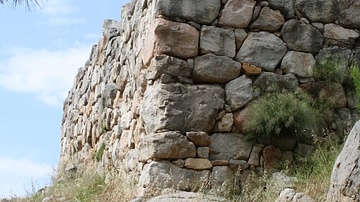
South Tower, Tiryns
Detail of the 'Cyclopean' walls of the south tower of Mycenaean Tiryns (13th century BCE).
Image
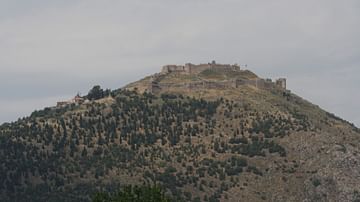
Acropolis of Argos
The Hill of Larissa, site of the ancient acropolis of Argos (6th to 5th century BCE). Visible today are the fortifications of the 10th century CE which incorporated some of the ancient polygonal walls, particularly on the north...
Image
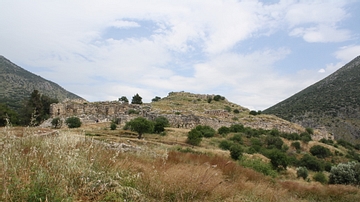
Mycenae
The Citadel of Mycenae, occupied from late Neolithic times until the twelfth century BCE. The Mycenaean civilization was at its peak from 1350-1200 BCE and it is from this period that the fortifications acquired the form seen today.
Image
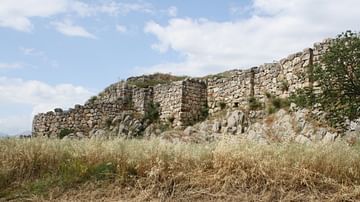
Tiryns
Tiryns was a major Mycenaean centre, the magnificent walled fortifications visible today date from the 13th century BCE. The large size of the stones of the walls led the ancient Greeks to believe they were the work of the Cyclopes.
Image
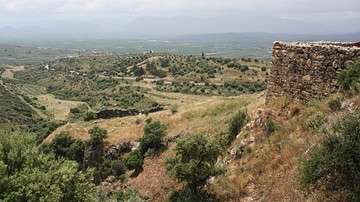
Citadel of Mycenae
The view to the south from the upper citadel of Mycenae looking towards Argos (1350 BCE).
