
Search
Search Results

Definition
Chandragupta Maurya
Chandragupta Maurya (c. 321 - c. 297 BCE), known as Sandrakottos (or Sandrokottos) to the Greeks, was the founder of the Maurya Dynasty (4th-2nd century BCE) and is credited with the setting up of the first (nearly) pan-Indian empire. Aided...

Definition
Brahmi Script
The Brahmi script is the earliest writing system developed in India after the Indus script. It is one of the most influential writing systems; all modern Indian scripts and several hundred scripts found in Southeast and East Asia are derived...

Image
Map of the East India Company Trade, c.1800
The English East India Company (EIC) was established by Royal Charter on 31 December 1600 under Queen Elizabeth I (reign 1558–1603), granting it a monopoly on English trade east of the Cape of Good Hope. Initially conceived as a commercial...

Image
Portuguese Nobles in India
A c. 1540 illustration of Portuguese nobles in India. The Portuguese had many coastal colonies in India, part of the Estado da India. From the Códice Casanatense (Biblioteca Casanatense, Rome)

Interview
Interview: Bejeweled Sri Lanka
The first comprehensive survey of Sri Lankan art organized by an American museum, The Jeweled Isle: Art from Sri Lanka, on show now at the LACMA in Los Angeles, California, presents some 250 works addressing nearly two millennia of Sri Lankan...

Definition
Periplus of the Erythraean Sea
The Periplus of the Erythraean Sea is an eyewitness account of ancient travel to Africa and India via the Red Sea written by an unknown Greek-speaking Egyptian author in the 1st century CE. In this detailed account, the conditions of the...
Definition
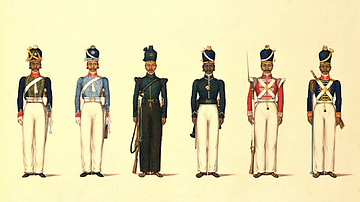
Sepoy
A sepoy was an Indian soldier in the armies of various states and European trading companies in the Indian subcontinent and then, from the second half of the 19th century, in the British Indian Army. Recruited from many different population...

Image
Port of Kollam, India
An early 17th-century illustration of Kollam (Quilon) in southern India which became a colony of the Portuguese empire in 1505. Part of the Portuguese Estado da India, a fort was built at Kollam in 1515.

Definition
First Anglo-Sikh War
The First Anglo-Sikh War (1845-6) was a short and bloody conflict won by the British East India Company (EIC) against the Sikh Empire. The EIC was keen to expand into northern India, but the Sikh army was a well-trained, well-equipped, and...

Definition
Second Anglo-Sikh War
The Second Anglo-Sikh War (1848-9) once again saw the British East India Company defeat the Sikh Empire in northern India. The war, which started off as a rebellion against British colonial rule, included the high-casualty Battle of Chillianwala...
