
Search
Search Results

Image
Robert Clive & The East India Company Rule in India, c. 1765
A map illustrating the transformation of the East India Company from a hopeful merchant venture in 1600 with isolated trade outposts governed by isolated and mostly independent town councils into a major ruler of large territories in India...
Teaching Material
British East India Company - Interactive Lesson for High School
This interactive world history lesson takes a deep dive into the British East India Company and its expansion across the Indian subcontinent. Using interactive slides, students work through an interactive timeline, interpret maps, and complete...
Article
Caste System in Ancient India - Varna Ideals in Vedic Times
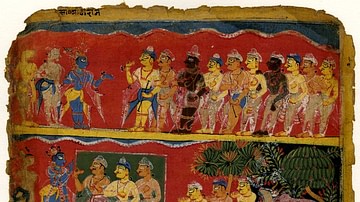
Ancient India in the Vedic Period (c. 1500-1000 BCE) did not have social stratification based on socio-economic indicators; rather, citizens were classified according to their Varna or castes. 'Varna' can literally mean 'colour' but in ancient...

Article
Opening the Way to India
Possibly being overjoyed by the tales of mythical exploits of Heracles, Semiramis, the fabled queen of Assyria, Cyrus, King of Persia and so on, Alexander the Great set out from the tiny kingdom of Macedon for a daring adventure, unheard...

Definition
Warren Hastings
Warren Hastings (1732-1818) was appointed the Governor of Bengal by the British East India Company (EIC) in 1772 and became its first Governor-General in India from 1774 to 1785. Under his tenure, the EIC ruthlessly expanded its territory...

Definition
Anglo-Maratha Wars
The three Anglo-Maratha Wars (1775-1819) were fought between the Maratha Confederacy of India (aka the Mahrattas, 1674-1818) and the British East India Company (EIC). The Maratha Hindu princes were rarely unified, and so the EIC steadily...

Definition
Robert Clive
Robert Clive (1725-1774), also known as 'Clive of India' and Baron Clive of Plassey, masterminded the expansion of the East India Company in India. Best known for his victory at Plassey in Bengal in 1757, Clive's reputation suffered in his...

Definition
Sepoy Mutiny
The 1857-8 Sepoy Mutiny (aka Sepoy Rebellion, Indian Mutiny, The Uprising or First Indian War of Independence) was a failed rebellion against the rule of the British East India Company (EIC) in India. Initially a mutiny of the Indian soldiers...

Definition
Jallianwala Bagh Massacre - The British Atrocity at Amritsar
The 13 April 1919 Jallianwala Bagh Massacre (aka Amritsar Massacre) was an infamous episode of brutality which saw General Dyer order his troops to open fire on an unarmed crowd of men, women, and children trapped in an abandoned walled garden...
Definition
Anglo-Mysore Wars
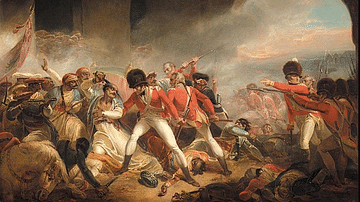
The Four Anglo-Mysore Wars (1767-1799) were fought between the British East India Company (EIC) and the state of Mysore. Haidar Ali and his son Tipu Sultan, the "Tiger of Mysore", were relentless foes to British expansion in southern India...
