
Search
Search Results

Article
The Portuguese Conquest of India
Throughout the 15th century, the Portuguese Crown yearned for a piece of the Far Eastern spice trade. For centuries this trade had been dominated by the Venetians who obtained pepper, cloves, nutmeg, ginger and cinnamon from their Middle...

Article
The Armies of the East India Company
The East India Company (EIC) was first England's and then Britain's tool of colonial expansion in India and beyond. Revenue from trade and land taxes from territories it controlled allowed the EIC to build up its own private armies, collectively...

Definition
Indian Princely States
The Indian Princely states (aka Native States or Princely India) were those states in the Indian subcontinent the British did not conquer but which were typically bound by treaty first to the East India Company and then to the British Crown...

Article
Plato: The Name and The Poet
Plato (l. c. 424/423 to 348/347 BCE), the Greek philosopher whose works have significantly shaped Western thought and religion, is said to have initially been a poet and playwright and, even if the primary source of this claim (the often...

Article
Naval Warfare in Ancient India
The navy in ancient India carried out three roles: it was used to transport troops to distant battlefields, participate in actual warfare, and was primarily meant for protecting the kingdom's trade on sea and navigable rivers and the maritime...

Article
Ancient Geography of India
The first text in Greek devoted entirely to India was written by Ctesias in the fourth century BCE. Only fragments of it survive. Yet he was probably the most widely quoted author on India, although Aristotle treated him with contempt. However...
Article
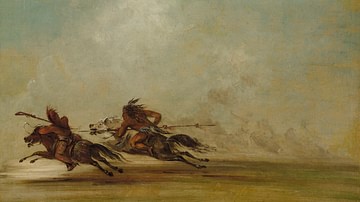
The Brave Who Went on the Warpath Alone and Won the Name of the Lone Warrior
The Brave Who Went on the Warpath Alone and Won the Name of the Lone Warrior is a Sioux tale in the tradition of the hero's journey in which a young person overcomes seemingly impossible challenges and is recognized as a great champion and...

Teaching Material
Enheduanna, the World's First Author Known by Name
This lesson introduces students to Enheduanna, an important but lesser-known female poet and her contributions to literature and history. Students will also consider how the role of women in history might change in various times and locations...
Article
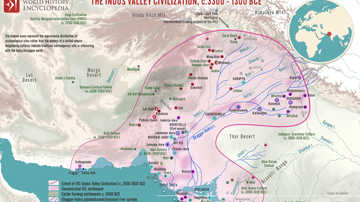
Religious Developments in Ancient India
For well over 1,000 years, sacred stories and heroic epics have made up the mythology of Hinduism. Nothing in these complex yet colourful legends is fixed and firm. Pulsing with creation, destruction, love, and war, it shifts and changes...

Article
Siege Warfare in Ancient India
Forts and sieges held a key position in ancient Indian warfare. Built on considerations of strategic location, topography, and the natural advantages provided by the site, forts would be heavily supplemented with man-made fortifications...
