
Search
Remove Ads
Advertisement
Search Results

Article
Siege of Khartoum - Last Stand of General Gordon
The siege of Khartoum from March 1884 to January 1885 was the most dramatic episode of the Mahdist War (1881-99) in Sudan when an army led by the inspirational Muslim leader, Muhammad Ahmad, the self-proclaimed...

Article
Thucydides on the Plague of Athens: Text & Commentary
The Plague of Athens (429-426 BCE) struck the city, most likely, in 430 BCE before it was recognized as an epidemic and, before it was done, had claimed between 75,000-100,000 lives. Modern-day scholars...

Article
Cyrus the Great's Conquests
The estimated expanse of the Achaemenid Empire at its height c. 500 BCE was two million square miles. Most of this territory was conquered by Cyrus the Great, the founder of the Empire, who reigned from 559 to 530 BCE...

Article
Battle of Omdurman - Britain's Vengeance for the Death of General Gordon
The Battle of Omdurman on 2 September 1898 saw General Kitchener lead an Anglo-Egyptian-Sudanese army to victory over 50,000 Mahdists in Sudan. The death of General Gordon during the...

Article
Bureaucracy in the Achaemenid Empire: Learning from the Past
In the early days of the Achaemenid Empire (c. 550-330 BCE), the kings came to realise that, if they were to be able to administer the vast mass of land and the multicultural people who inhabited...

Article
Why Did Britain & France Appease Hitler?
The policy of appeasement towards the demands of Adolf Hitler (1889-1945) regarding Nazi Germany's territorial expansion ultimately failed when the Second World War (1939-45) began. The reasons appeasement...
Article
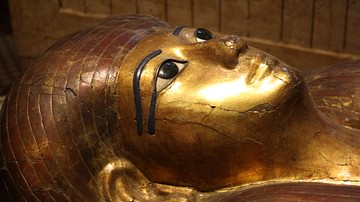
Herodotus on Burial in Egypt
Herodotus' section of his Histories on burial in ancient Egypt (Book II.85-90) is an accurate description of Egyptian mummification, but he purposefully omits the spiritual significance of embalming in keeping with his...

Article
How the United Nations was Born from WWII
The Allies met in several conferences from 1941 to 1945 to discuss how to guarantee a more peaceful and cooperative world once the Second World War (1939-45) was concluded. To foster global cooperation, facilitate...

Article
Elephants in Hellenistic History & Art
Elephants were thought of as fierce and frightful monsters in antiquity, very real though rarely seen until the Hellenistic period. They were deployed on the battlefield to strike terror into the enemy, however...

Article
Parthia: Rome's Ablest Competitor
As a superpower in its own right and in competition with Rome, Parthia's empire - ruling from 247 BCE to 224 CE - stretched between the Mediterranean in the west to India in the east. Not only did the Parthians win...
