
Search
Remove Ads
Advertisement
Search Results

Article
Origins of World Agriculture
Agriculture arose independently at several locations across the world, beginning about 12,000 years ago. The first crops and livestock were domesticated in six rather diffuse areas including the Near East, China, Southeast...

Article
The Plague at Athens, 430-427 BCE
In the second year of the Peloponnesian War, 430 BCE, an outbreak of plague erupted in Athens. The illness would persist throughout scattered parts of Greece and the eastern Mediterranean until finally dying out...

Article
The Twelve Tribes of Israel
The Twelve Tribes of Israel refer to the sons of the Jewish Patriarch Jacob and are important for the tribal lineages of those who constituted the nation of Israel. In the ancient world, all ethnic groups developed stories...

Article
The Search for the Source of the Nile - Solving Geography's Last Great Riddle
The search for the source of the Nile River was one of the last great geographical mysteries of 19th-century European exploration. Men like Livingstone, Burton, Speke, and Stanley...
Article
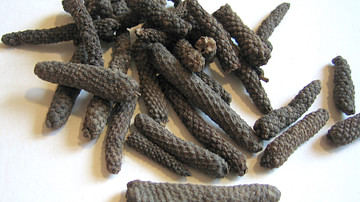
Middle Eastern Power Shifts & the Trade of Pepper from East to West
Pepper has long been the king of spices and for almost 2,000 years dominated world trade. Originating in India, it was known in Greece by the 4th century BCE and was an integral part of...

Article
Depictions of India in Ancient Literature
Herodotus (484 BCE – c. 425 BCE) has been called the Father of History since he was the first historian known to collect his materials in detail, test their accuracy to a certain extent and arrange them in...

Video
Aksum (UNESCO/NHK)
The ruins of the ancient city of Aksum are found close to Ethiopia's northern border. They mark the location of the heart of ancient Ethiopia, when the Kingdom of Aksum was the most powerful state between the Eastern Roman Empire...

Image
Mussolini's Head Sculpture in Adwa
Monumental sculpture of the head of Benito Mussolini, the leader of fascist Italy from 1922 to 1945, realised in 1935 near Adwa, Ethiopia. The sculpture was later demolished during the Second World War (1939-45).
Image
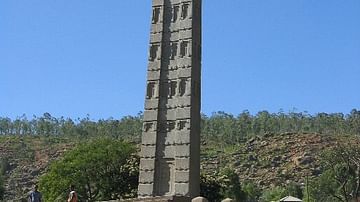
Royal Obelisk, Axum
A stone monolithic obelisk marking the tomb of King Ezanas of the kingdom of Axum (aka Aksum, modern Ethiopia), c. 400 CE. The carvings imitate the architectural features of dry-stone and timber housing.

Image
Italian Prisoners of the First Italo-Ethiopian War
Italian prisoners of war at Harar, capital of the Ethiopian province of the same name. The soldiers, made prisoners during the First Italo-Ethiopian War, are awaiting repatriation to Italy. The picture...
