
Search
Remove Ads
Advertisement
Search Results

Image
Saint George's Church, Lalibela
Church of Saint George at Lalibela, Ethiopia, 11-12th century.

Video
Tiya (UNESCO/NHK)
Tiya is among the most important of the roughly 160 archaeological sites discovered so far in the Soddo region, south of Addis Ababa, Ethiopia. The site contains 36 monuments, including 32 carved stelae covered with symbols...

Video
Rock-Hewn Churches, Lalibela (UNESCO/NHK)
The 11 medieval monolithic cave churches of this 13th-century 'New Jerusalem' are situated in a mountainous region in the heart of Ethiopia near a traditional village with circular-shaped dwellings. Lalibela...

Definition
Helen of Troy
Helen of Troy (sometimes called Helen of Sparta) is a figure from Greek mythology whose elopement with (or abduction by) the Trojan prince Paris sparked off the Trojan War. Helen was the wife of Menelaus, the king of Sparta, and...

Image
Negus Menelik II
A photograph of the Ethiopian emperor (Negus) Menelik II (reign 1889-1913) wearing his coronation robes and regalia.

Image
Mycenean Greece and the Orient about 1450 BC
Mycenean Greece and the Orient about 1450 BC. Inset: Reference Map of the Nile Delta.

Image
Group of Ethiopian Ras Pledging Allegiance to Mussolini
The Abyssinian leaders Ras Seyum Mangasha (1887-1960), Ras Ghetacciù Abaté, and Ras Kebbedé Guebret, received in Rome by Benito Mussolini (1883-1945) on 6 February 1937, swear allegiance after Abyssinia's...

Image
The Siege of Mekelle as Portrayed in the Italian Press
Cover for the article 'A Makallè (1896) L'Uscita del presidio dal forte' (2 February 1896) appeared on the newspaper La Tribuna Illustrata (Anno IV, N. 5). During the first Italo-Ethiopian war, the...

Image
A Painting of the Battle of Gondar (1941)
Ethiopian painting depicting the Battle of Gondar (13–27 November 1941) during the last stages of the East African Campaign in WWII. After the fall of Amba Alagi in May 1941 and Jimma in July, Gondar was the...
Image
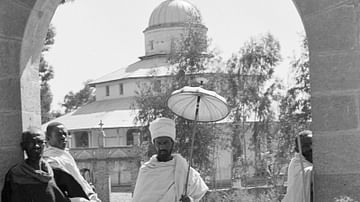
Ethiopian Monastery of Debre Libanos in 1934
Monastery of Debre Libanos founded by Saint Tekla Haymanot in 1284. Photo by Walter Mittelholzer, published in his book Abessinienflug (Trip to Abysinnia), 1934.
ETH Library, Zürich.
