
Search
Remove Ads
Advertisement
Search Results

Definition
Salona
Salona was an ancient city located at the estuary of the river Jadro in present-day Solin, a suburb of Split on the Adriatic coast of Croatia. It became the capital of the Roman province of Dalmatia in 9 CE. Before the Romans Salona...

Definition
Huns
The Huns were a nomadic tribe prominent in the 4th and 5th century whose origin is unknown but, most likely, they came from "somewhere between the eastern edge of the Altai Mountains and the Caspian Sea, roughly modern Kazakhstan" (Kelly...
Definition
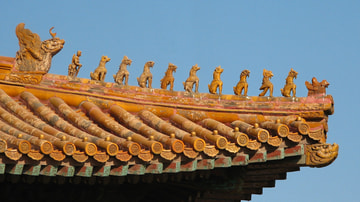
Ancient Chinese Architecture
Walled compounds, raised pavilions, wooden columns and panelling, yellow glazed roof tiles, landscaped gardens, and a careful application of town planning and use of space are all notable features of the architecture...

Definition
Leptis Magna
Leptis Magna (aka Lepcis Magna), located in western Libya, North Africa, was a Phoenician city founded by Tyre in the 7th century BCE. Continuing to be a major city in the Roman period, it was the birthplace of Emperor Septimius...
Article
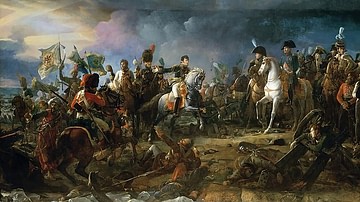
Battle of Austerlitz
The Battle of Austerlitz (2 December 1805), or the Battle of the Three Emperors, was one of the most significant battles of the Napoleonic Wars (1803-1815). It saw French Emperor Napoleon I (r. 1804-1814; 1815) and his Grande...

Interview
Rubin Museum's Faith and Empire: Tibetan Buddhist Art
Faith and Empire: Art and Politics in Tibetan Buddhism, a new exhibition at the Rubin Museum of Art in New York, explores the dynamic historical intersection of politics, religion, and art as reflected...
Article
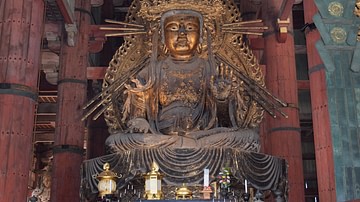
Buddhism in Ancient Japan
Buddhism was introduced to ancient Japan via Korea in the 6th century CE with various sects following in subsequent centuries via China. It was readily accepted by both the elite and ordinary populace because it confirmed...

Article
Mythological Re-Enactments in Ancient Roman Spectacle
To this day the ancient Romans remain infamous for their dramatic use of spectacle and other forms of entertainment. A lesser known variation of Roman spectacle is the mythological re-enactments that...
Article
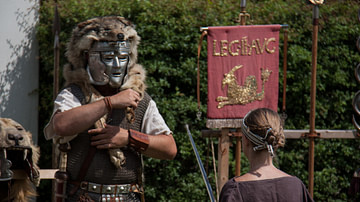
Legions of Britain
After the Roman emperor Claudius (r. 41-54 CE) successfully conquered Britain in 43 CE, four legions were left there to maintain the peace: XIV Gemina, II Augusta, IX Hispana, and XX Valeria Victrix. However, by the end of the...
Article
Legions of Syria
The Roman legions of Syria served as a buffer, protecting the Roman Empire not only externally from such threats as Parthia and the Sasanian Empire but also internally during the Great Jewish Revolt of 66 CE and the Bar-Kochba...
