
Search
Remove Ads
Advertisement
Search Results

Definition
Meiji Period
The Meiji period refers to the period in Japanese history from 1868 to 1912 during which the Meiji Emperor reigned. Following the overthrow of the Tokugawa shogunate in the Meiji Restoration of 1868, Japan's new leaders embarked...

Definition
Mystras
The city of Mystras (or Mistras) in southern Greece was the provincial capital of the Byzantine Despotate of the Morea from the 13th through the 15th centuries CE. It was founded in 1249 CE by William II of Villehardouin, and it served...

Definition
Roman Legionary
The Roman legionary was a well-trained and disciplined foot soldier, fighting as part of a professional well-organized unit, the legion (Latin: legio), established by the Marian Reforms. While major tactical changes appeared during...

Article
Legions of Late Antiquity
The Roman army underwent dramatic changes in Late Antiquity. Civil war and external conflicts led to the creation of new legions while existing legions were either split or disbanded. Although there was an increase in...

Article
Royal Women in the Mughal Empire
It was not only the Mughal emperors that left an indelible mark in the history of the Indian subcontinent but also the queens and princesses. The latter's contributions to art, architecture, literature, cuisine, refinement...
Article
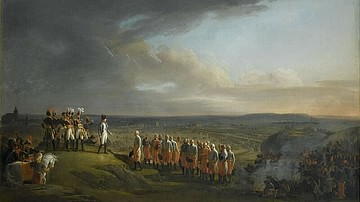
Ulm Campaign
The Ulm Campaign (25 September to 20 October 1805) was a military operation during the War of the Third Coalition (1805-1806). Through a series of maneuvers, the 210,000 men of the French Grande Armée, led by Emperor Napoleon I...

Article
Zenobia's Rebellion in the Historia Augusta
The Historia Augusta (Great History) is a Latin work of the 4th century CE that chronicles the lives of Roman emperors from 117-285 CE. Among the many stories related is the history of Zenobia of Palmyra...

Article
Religion in Ancient China
Religious practices in ancient China go back over 7,000 years. Long before the philosophical and spiritual teachings of Confucius and Lao-Tzu developed or before the teachings of the Buddha came to China, the people worshipped...

Article
The Integration of Church and State in the Roman Empire
In the ancient world, "religion" and society were not separate entities. Various gods dictated covenants, "law-codes," and social conventions. Such law-codes were most often the responsibility of...

Article
1453: The Fall of Constantinople
The city of Constantinople (modern Istanbul) was founded by Roman emperor Constantine I in 324 CE and it acted as the capital of the Eastern Roman Empire, or Byzantine Empire as it has later become known, for well...
