
Search
Remove Ads
Advertisement
Search Results

Video
Anubis: The Egyptian Jackal-Headed God of Mummifaction and the Afterlife
Anubis is the jackal-headed Egyptian god of mummification and the afterlife. He is depicted both as a jackal, and as a man with the head of a jackal. Anubis as a man is often depicted...
Image
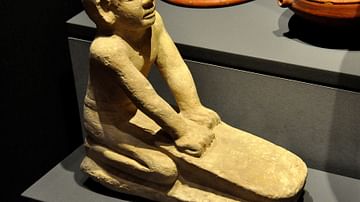
Statue of an Ancient Egyptian Servant
Limestone statue of an Egyptian servant grinding flour. From modern-day Egypt. Old Kingdom, 6th Dynasty, 2250 BCE. (State Museum of Egyptian Art, Munich, Germany).

Article
Food & Drink in Ancient Egypt
Food and drink in ancient Egypt relied on barley and wheat, the primary crops cultivated along the Nile. The Egyptian diet was based on bread, beer, and vegetables. Meat was expensive and only rarely eaten. The majority...

Definition
Ancient Israelite Art
Ancient Israelite art traditions are evident especially on stamps seals, ivories from Samaria, and carvings, each with motifs connecting it to more general artistic traditions throughout the Levant. Ancient Israel, and therefore...

Definition
The Ankh
The Ankh is one of the most recognizable symbols from ancient Egypt, known as "the key of life" or "cross of life" and dated to the Early Dynastic Period (c. 3150 - 2613 BCE). It is a cross with a loop at the top sometimes ornamented...
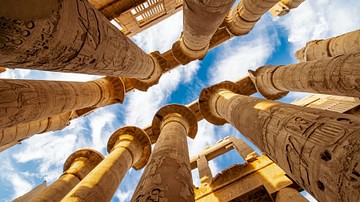
Image Gallery
A Gallery of Ancient Egyptian Temples
The temple in ancient Egypt was the home of the deity it was built for, and the clergy attended the statue of that god or goddess as they would a living person. Every temple was designed with a forecourt, a reception...
Image
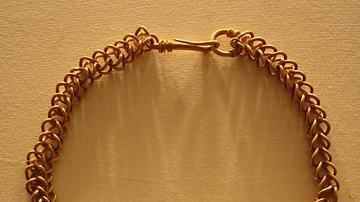
Egyptian Necklace
A gold and lapiz lazuli necklace from Egypt, New Kingdom, 1550-1075 BCE. (National Archaeological Museum, Athens)

Image
Egyptian Model of Peasants Ploughing
Model of peasants ploughing from Egypt. 11th or 12th Dynasty, c. 2025-1850 BCE.
The British Museum, London.

Image
Ancient Egyptian Music and Dancing
This painting from the Tomb of Nebamun (c. 1350 BCE) shows women making music and other almost naked women dancing.

Definition
Writing - The Preservation of Human Thought and Action
Writing is the physical manifestation of a spoken language. It is thought that human beings developed language circa 35,000 BCE as evidenced by cave paintings from the period of the Cro-Magnon Man...
