
Search
Remove Ads
Advertisement
Search Results

Image
Face from an Egyptian Coffin
A face of a woman fragment from an Egyptian coffin. New Kingdom of Egypt, 18th-20th Dynasty, 1550-1070 BCE.
Egyptian Museum, Turin.

Image
Egyptian Beadnet Dress (Detail)
Egyptian beadnet dress from the reign of Khufu, 4th Dynasty, Old Kingdom of Egypt, 2551-2528 BCE. This beadnet dress is the earliest surviving example of a garment with the lozenge pattern. This pattern is frequently...
Image
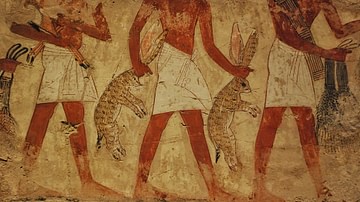
Egyptian Desert Hare Hunting
An Egyptian servant is carrying two desert hares as an offering to Nebamun, a rich Egyptian accountant. Detail of a larger procession of agricultural offerings, from the tomb of Nebamun (c. 1350 BCE). The British Museum...

Image
Die Like an Egyptian: How to Reach the Field of Reeds (Aaru) - An Afterlife Guide from New Kingdom Egypt (c. 1550-1069 BCE)
Ancient Egyptian beliefs about the afterlife centered on the idea that death marked the beginning of a spiritual journey rather than the end...

Definition
Osiris
Osiris is the Egyptian Lord of the Underworld and Judge of the Dead, brother-husband to Isis, and one of the most important gods of ancient Egypt. The name `Osiris' is the Latinized form of the Egyptian Usir which is interpreted as 'powerful'...

Definition
Carthaginian Art
The art of the Carthaginians was an eclectic mix of influences and styles, which included Egyptian motifs, Greek fashion, Phoenician gods, and Etruscan patterns. Precious metals, ivory, glass, terracotta, and stone were transformed...

Definition
Nitocris
Nitocris (2184-2181 BCE) is the Greek name for Nitiqret, the last monarch of the 6th Dynasty of Egypt which concluded the period of the Old Kingdom (c. 2613-2181 BCE). Nitocris is best known from the story told of her by Herodotus (484-425/413...

Definition
Heka
Heka is the god of magic and medicine in ancient Egypt and is also the personification of magic itself. He is probably the most important god in Egyptian mythology but is often overlooked because his presence was so pervasive as to make...

Image
Egyptian Door Jamb
Limestone fragment of a door jamb from the temple of Seth (built by the Egyptian pharaoh Thutmose III) at Ombos (Naqada), Egypt, 18th Dynasty, 1543-1292 BCE. The Petrie Museum of Egyptian Archaeology, London (With thanks to...

Article
Music & Dance in Ancient Egypt
Music and dance were highly valued in ancient Egyptian culture, but they were more important than is generally thought: they were integral to creation and communion with the gods and, further, were the human response...
