
Search
Remove Ads
Advertisement
Search Results

Article
Pirates of the Mediterranean
The pirates of the ancient Mediterranean were not, for the most part, the outsiders who knew no country's allegiance and were the enemies of civilization as they are frequently depicted in novels and other media. They...
Definition
First Dynasty of Egypt
The kings of the First Dynasty of Egypt (c. 3150 - c. 2890 BCE) all worked toward the same ends: increasing trade, expansion of the kingdom through military campaigns, engaging in building projects (such as monuments, tombs...
Article
Female Physicians in Ancient Egypt
A famous story from Greece relates how a young woman named Agnodice wished to become a doctor in Athens but found this forbidden. In fact, a woman practicing medicine in Athens in the 4th century BCE faced the death...

Definition
Script - The Written Record of Humanity
Script is the written expression of a language. Cuneiform, the first script, was invented in Sumer, Mesopotamia, circa 3600/3500 BCE; hieroglyphics sometime prior to the Early Dynastic Period in Egypt (circa...

Definition
Ma'at
Ma'at (pronounced may-et) is the ancient Egyptian goddess of truth, justice, harmony, and balance (a concept known as ma'at in Egyptian) who first appears during the period known as the Old Kingdom (c. 2613 - 2181 BCE) but no doubt existed...

Definition
Bes
Bes is the ancient Egyptian god of childbirth, fertility, sexuality, humor, and war, but served primarily as a protector god of pregnant women and children. He is regularly depicted as a dwarf with large ears, long-haired and bearded, with...
Article
Letters to the Dead in Ancient Egypt
The question of what happens after death has been addressed by religious beliefs and philosophies of every world culture throughout recorded history and ancient Egypt is famous for its own response to the mysteries...
Article
The Forty-Two Judges
The Forty-Two Judges were divine entities associated with the afterlife in ancient Egypt and, specifically, the judgment of the soul in the Hall of Truth. The soul would recite the Negative Confession in their presence as...
Article
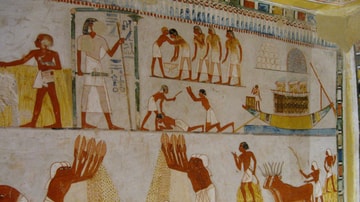
Jobs in Ancient Egypt
In ancient Egypt, the people sustained the government and the government reciprocated. Egypt had no cash economy until the coming of the Persians in 525 BCE. The people worked the land, the government collected the bounty...
Article
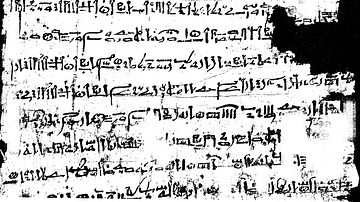
The Report of Wenamun & the Perils of Living in the Past
The Report of Wenamun (also known as The Tale of Wenamun or The Report of Wenamon) is an Egyptian literary work dated to c. 1090-1075 BCE toward the end of the New Kingdom (c.1570 - c. 1069 BCE...
