
Search
Remove Ads
Advertisement
Search Results

Definition
Serket
Serket (also known as Serqet, Selkis, and Selket) is an Egyptian goddess of protection associated with the scorpion. She was worshipped widely in Lower Egypt as a great Mother Goddess in the Predynastic Period (c. 6000- c. 3150 BCE) and...

Definition
Pirates in the Ancient Mediterranean
Piracy, defined as the act of attacking and robbing a ship or port by sea, had a long history in the ancient Mediterranean stretching from the time of the Egyptian pharaoh Akhenaten (r. 1353-1336 BCE) and throughout...
Image
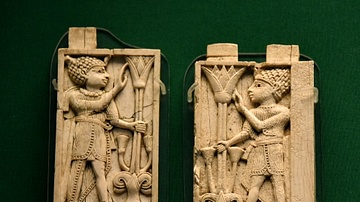
Nimrud Ivory Panels of Two Egyptian Kings
Two panels from a much larger composition, each showing a youth dressed in Egyptian royal costume grasping a tree formed by a lotus flower arising from a double volute. On the front of the lower right-hand...
Image
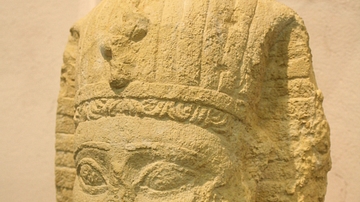
Egyptian Sphinx Head
Limestone sphinx head from the Ptolemaic period, Medinet Madi, Temple of Isis-Thermutis. (Egyptian Museum, Castello Sforzesco, Milan)
Image
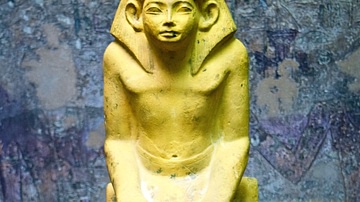
Statuette of Egyptian Governor Khnumnakht
Made from limestone, this statuette shows the ancient Egyptian governor Khnumnakht. He was a contemporary of Djehutihotep—the fifteenth nomos of Upper Egypt— who lived during the twelfth dynasty (c. 1985-1773...
Image
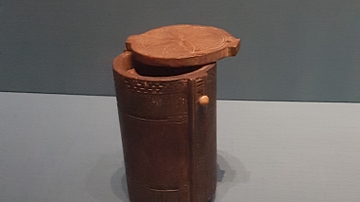
Egyptian Cosmetic Box
Egyptian cosmetic box. New Kingdom, about 1550-1069 BCE. Thebes, Egypt. From The British Museum, (photo taken at The Powerhouse Museum, Sydney, Australia) This wooden cosmetic box is delicately incised with a leaf motif...
Image
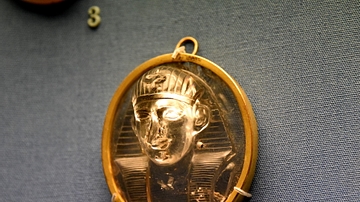
Cameo of an Egyptian King
This rock-crystal cameo depicts a king in an Egyptian style; popular in Italy, where it was probably made. Roman period, 1st century CE. (The British Museum, London).

Image
Egyptian Model Chariot
The Egyptian god Bes is depicted on the front of this gold model chariot. Bes was the protective deity of the young, and this would suggest the chariot was made for a child. Chariots with the same profile and the wheel construction...

Image
Egyptian Sistrums
Four Egyptian copper alloy/faience sistrums (musical rattles) depicting goddesses (Hathor and Isis). Late Period of ancient Egypt or Ptolemaic Period.
National Archaeological Museum, Athens.

Image
Egyptian Baboon Sculpture
This ancient Egyptian sculpture made of basalt dates from the 13th century BCE and depicts a seated baboon. The baboon was associated with Thoth—the god of wisdom, science, and measurement. Baboons were thus often represented...
