
Search
Did you mean: Eos?
Remove Ads
Advertisement
Search Results

Definition
Seshat
Seshat (also given as Sefkhet-Abwy and Seshet) is the Egyptian goddess of the written word. Her name literally means "female scribe" and she is regularly depicted as a woman wearing a leopard skin draped over her robe with a headdress...

Definition
Castor and Pollux
Castor and Pollux (the Dioscuri) are figures from Greek and Roman mythology considered the twin sons of Zeus or Jupiter. Semi-divine figures, the twins were credited with the role of saving those in trouble at sea or in grave...

Definition
Giovanni Boccaccio
Giovanni Boccaccio (1313-1375) was an Italian poet, writer, and scholar. His most famous and influential work is the Decameron, completed by 1353, in which his ten characters present 100 tales of everyday life. The book covers...

Definition
Silla
The Silla kingdom ruled south-eastern Korea during the Three Kingdoms period from the 1st century BCE to 7th century CE. The capital was Geumseong (Gyeongju) with a centralised government and hierarchical system of social ranks. The prosperity...

Definition
Carthaginian Art
The art of the Carthaginians was an eclectic mix of influences and styles, which included Egyptian motifs, Greek fashion, Phoenician gods, and Etruscan patterns. Precious metals, ivory, glass, terracotta, and stone were transformed...

Definition
Chitrali Mythology
Chitrali mythology developed in the region of Chitral, the tallest portions of the Hindu Kush mountains, where the Chitrali people, at the juncture of South, Central, West, and East Asia, were exposed to many external cultural...
Definition
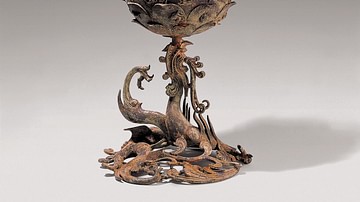
Baekje
Baekje (Paekche) was one of the Three Kingdoms which ruled over ancient Korea from the 1st century BCE to the 7th century CE. Controlling territory in the south-western part of the peninsula the kingdom was in constant rivalry with the...
Definition
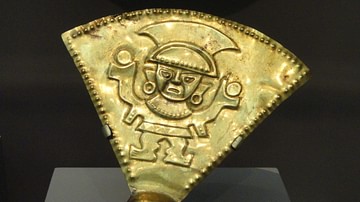
Chimu Civilization
The Chimu civilization, otherwise called the kingdom of Chimor, flourished on the northern coast of Peru between the 12th and 15th centuries CE. With their capital at Chan Chan, the Chimu were the largest and most prosperous...

Definition
Ymir
Ymir is a primordial giant, closely linked to the creation myth and the beginning of the world in Norse mythology. A creature resulting from the dramatic encounter between ice and fire, he was fed by a cosmic cow and his body parts served...

Definition
Gyeongju
Gyeongju (Kyongju), formerly known as Seorabeol or Saro, was the capital of the Silla kingdom of ancient Korea from the 1st century BCE to the 10th century CE. Located in the south-east of the Korean peninsula, at its peak in the 9th...
