
Search
Remove Ads
Advertisement
Search Results
Image
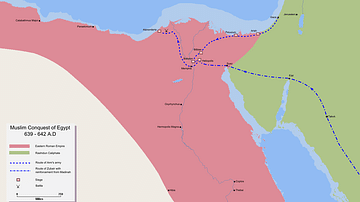
Muslim Conquest of Egypt, 640-642 CE
A map showing the conquest of Byzantine Egypt by the Rashidun Caliphate (640-642 CE), led by Amr ibn al-Aas and al-Zubayr ibn al-Awamm.

Interview
Interview: Early Medieval Irish Book Art
Early medieval Irish book art is both beautiful and fascinating. It reflects a flourishing monastic culture which played a key role in the cultural development of Europe from the 6th to 9th centuries. Nowhere is this more clearly illustrated...

Definition
Seventh Crusade
The Seventh Crusade (1248-1254 CE) was led by the French king Louis IX (r. 1226-1270 CE) who intended to conquer Egypt and take over Jerusalem, both then controlled by the Muslim Ayyubid Dynasty. Despite the initial success of capturing Damietta...

Article
Early Judaism
During the period of early Judaism (6th century BCE - 70 CE), Judean religion began to develop ideas which diverged significantly from 10th-to-7th-centuries BCE Israelite and Judean religion. In particular, this period marks a significant...

Article
Ten Should-Be Famous Women of Early Christianity
There were many famous women of early Christianity who made significant contributions to the development of the faith but have since been largely forgotten. Some have been canonized by the Church or recognized in other ways, but their efforts...
Article
Battle of Yarmouk
The Battle of Yarmouk River (or Yarmuk River; also written as the Battle of Jabiya-Yarmuk) was fought over the course of six days, from 15 to 20 August 636 CE, between the Muslim army of the Rashidun Caliphate (632-661 CE), under Khalid ibn...

Article
The Early History of Clove, Nutmeg, & Mace
The spices clove, nutmeg, and mace originated on only a handful of tiny islands in the Indonesian archipelago but came to have a dramatic, far-reaching impact on world trade. In antiquity, they became popular in the medicines of India and...

Article
The Armies of the Crusades
The armies of the Crusades (11th-15th centuries CE), which saw Christians and Muslims struggle for control of territories in the Middle East and elsewhere, could involve over 100,000 men on either side who came from all over Europe to form...

Definition
Abd al-Rahman I
Abd al-Rahman was the founder of the Emirate of Cordoba and ruled as Abd al-Rahman I from 756-788 CE. As one of the lone survivors of the Umayyad Dynasty after the Abbasids defeated the Umayyad Caliphate, Abd al-Rahman bridged the Umayyad...

Article
Napoleon Bonaparte During the Early French Revolution (1789-1794)
Of all the careers that soared to meteoric heights during the chaotic decade of the French Revolution (1789-1799), none was more spectacular nor impactful than that of Napoleon Bonaparte (1769-1821). From an unremarkable birth into minor...
