
Search
Did you mean: Ur?
Search Results

Image
Sargon II Wall Relief
Sargon II (r. 722-705 BCE), one of the most important kings of the Neo-Assyrian Empire and founder of the Sargonid Dynasty, with a dignitary on a low-relief from the left wall of the palace of Sargon II at Dur Sharrukin in Assyria, now Khorsabad...

Image
Hero Vanquishes Lion (Khorsabad)
Colossal figure in the facade of the palace of Sargon II in Dur-Sharrukin. Drawing Flandin PL 41 by Paul-Emile Botta (1802-1870 CE), c. 1849 CE.
Image
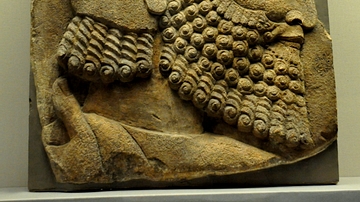
Head of a Tribute Bearer from Khorsabad
This alabaster bas-relief shows a head of a bearded man. The fragment was part of a larger relief which depicts a procession of tribute bearers. The man's turban and his hair style and beard suggest that the man came from the western part...

Video
Lamassu from the citadel of Sargon II
Lamassu (winged human-headed bulls possibly lamassu or shedu) from the citadel of Sargon II, Dur Sharrukin (now Khorsabad, Iraq), Neo-Assyrian, c. 720-705 B.C.E., gypseous alabaster, 4.20 x 4.36 x 0.97 m, excavated by P.-E. Botta 1843-44...

Definition
Mesopotamia - The Beginning of Beginnings
Mesopotamia (from the Greek, meaning "between two rivers") was an ancient region located in the Near East (Middle East) bounded in the northeast by the Zagros Mountains and in the southeast by the Arabian Plateau, corresponding to modern-day...

Definition
Ziggurat - Mountains of the Gods
A ziggurat is a form of monumental architecture originating in ancient Mesopotamia, which usually had a rectangular base and was built in a series of steps up to a flat platform upon which a temple was raised. The ziggurat was an artificial...

Definition
Mesopotamian Art and Architecture - The Birth of Art and Architecture in the Ancient World
Ancient Mesopotamian art and architectural works are among the oldest in the world, dating back over 7,000 years. The works first appear in northern Mesopotamia prior to the Ubaid period (circa 6500-4000 BCE) and then developed in the south...

Definition
Mesopotamian Literature - The Earliest Works of the Imagination
Ancient Mesopotamian literature developed circa 2600 BCE after scribes, who had formerly been record-keepers, began composing original works in the region of Sumer. The Sumerians invented writing circa 3600/3500 BCE, refined the script circa...

Definition
Ashur - The First Great Assyrian City
Ashur (also known as Assur) was an Assyrian city located on a plateau above the Tigris River in Mesopotamia (today known as Qal'at Sherqat, al-Shirqat District, northern Iraq). The city was an important center of trade, as it lay squarely...

Definition
Neo-Assyrian Empire
The Neo-Assyrian Empire (912-612 BCE) was the final stage of the Assyrian Empire, stretching throughout Mesopotamia, the Levant, Egypt, Anatolia, and into parts of Persia and Arabia. Beginning with the reign of Adad Nirari II (912-891 BCE...
