
Search
Did you mean: Ur?
Search Results

Article
The Banquet Stele of Ashurnasirpal II
When he came to the throne in 884 BCE, Ashurnasirpal II had to attend to revolts which broke out across the empire. He ruthlessly put down all rebellions, destroyed the rebel cities and, as a warning to others, impaled, burned, and flayed...

Image
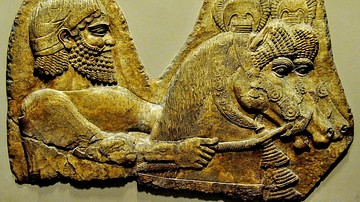
Hero Overpowering a Lion
The Hero Overpowering a Lion, gypseous alabaster high relief with traces of paint from Khorsabad (Dur Sharrukin), facade N of the throne room of the palace of Sargon II, Assyria (Iraq). Neo-Assyrian Empire, reign of Sargon II, 721-705 BCE...
Image
A Groom and Horses from Western Assyria
This scene is part of a large alabaster bas-relief which shows a tributary procession from Western Assyria (probably in modern-day Syria or Turkey). Here, we can see a groom leading two horses. From Khorsabad (ancient Dur-Sharrukin), in modern-day...

Image
Archer Relief, Khorsabad
This gypsum relief, which depicts an archer, was part of a larger wall relief that demonstrates the Assyrian army and Sargon II's attack on the city of Amqaruna (Biblical Ekron) in central Palestine, probably in 720 BCE. The archer holds...

Image
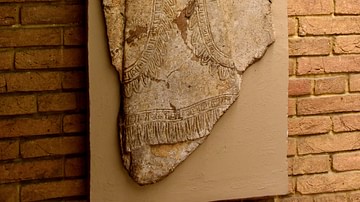
Sargon II and Sennacherib
Gypsum wall relief depicting the Assyrian king Sargon II, who holds a long staff, greets a high official (who still holds a sword at his side), in very close proximity, almost touching him. This official is probably his son, Sennacherib...
Image
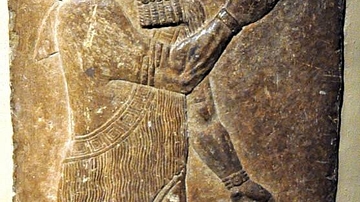
Tribute-Bearer from Syria or Turkey
This is one of a long procession of tribute bearers seen arriving from modern-day Syria or Turkey, on the western fringes of the Assyrian Empire. Neo-Assyrian Period, reign of Sargon II, 710-705 BCE. From Room X of the Royal Palace at Khorsabad...
Image
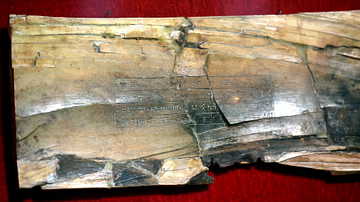
Ivory Writing-Board from Nimrud
This is the outer cover of the ivory writing-boards (6 in number) incised with four lines of Assyrian cuneiform text, giving the title of the astrological script which was a compilation of omens ordered by Neo-Assyrian king Sargon II (reigned...
Image
Assyrian Protective Spirit from Khorsabad
This gypsum wall relief of a protective spirit (sage) was found at the palace of Sargon II at the city of Khorsabad (ancient Dur-Sharrukin), northern Mesopotamia. Iraq. Neo-Assyrian period, 710-705 BCE. (The British Museum, London).
Image
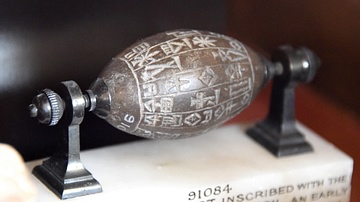
Macehead with the Name of Anum-mutabil
This oval stone mace-head was inscribed with the name of Anum-mutabil (formerly read as Ilum-muttabbil), governor of the Babylonian city Dur-ilu. The cuneiform inscription reads "Ilum-muttabbil, mighty man, favorite of god Istaran, beloved...
Image
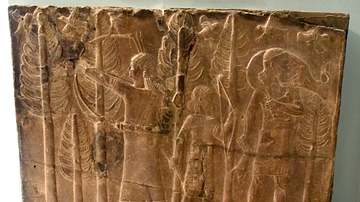
Hunting Scene from Khorsabad
This unusual scene (in black stone) came from a detached building on the private side of the palace, possibly reserved for royal use. It was one of the few discoveries made at Khorsabad by Henry Layard. Neo-Assyrian Period, reign of Sargon...
