
Search
Did you mean: Trajan?
Remove Ads
Advertisement
Search Results

Article
Gilgamesh and Huwawa - The Epic Battle of the Cedar Forest
Gilgamesh and Huwawa is a Sumerian poem relating the expedition of Gilgamesh and Enkidu to the Cedar Forest and the slaying of the monster-demon Huwawa. The work predates and informs The Epic of...

Article
The Life of Hercules in Myth & Legend
Hercules is the Roman name for the Greek hero Herakles, the most popular figure from ancient Greek mythology. Hercules was the son of Zeus, king of the gods, and the mortal woman Alcmene. Zeus, who was always...

Article
Cavalry in Ancient Chinese Warfare
The use of cavalry in Chinese warfare was a significant development which was largely responsible for the abandonment of chariots, that vehicle being much slower and more cumbersome to manoeuvre in battle conditions...

Article
Viking Prophecy: The Poem Völuspá of the Poetic Edda
The Völuspá (Old Norse: Vǫluspá) is a medieval poem of the Poetic Edda that describes how the world might have come into shape and would end according to Norse mythology. The story of about 60 stanzas...

Article
The Dutch Discovery of Australia
17th-century Dutch East India Company (Vereenigde Oostindische Compagnie or VOC) navigators were the first Europeans to set foot on Australian soil. Although there is a strong theory that the Portuguese explorer...

Article
Enlil in the E-kur - Praising God in Ancient Mesopotamia
Enlil in the E-Kur (circa 2000 BCE) is a Sumerian hymn praising the sky god Enlil, his temple/ziggurat at Nippur, and his consort Ninlil, depicting all three in glowing terms and Enlil as a creator...

Article
Ten Native American Legendary Creatures You Need to Know
Native American lore features many legendary creatures and supernatural entities that were understood as beneficial to humanity but just as many that posed serious threats to be avoided. These beings...

Article
The Curse of Agade - Naram-Sin's Fictional Battle with the Gods
The Curse of Agade (also given as The Cursing of Agade) is a poem dated to the Ur III period of Mesopotamia (circa 2112 to circa 2004 BCE), though it is thought to be somewhat older in origin...
Article
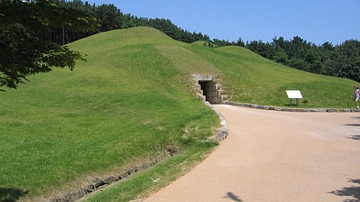
The Tomb of King Muryeong
The tomb of king Muryeong is perhaps one of the most impressive tombs from the Baekje kingdom of ancient Korea, both in its design and the treasure found inside it. Muryeong-Wang (also Munyeong or Muryong) reigned from...

Article
Liangzhu Culture Jade
Jade artifacts and icons are almost synonymous with the Chinese culture going back thousands of years. Jade (nephrite) was first worked into recognizable objects c. 6000 BCE during the period of the Houli Culture (c. 6500...
