
Search
Remove Ads
Advertisement
Search Results

Definition
Nuremberg Trials
The Nuremberg trials (1945-6), held in Nürnberg (Nuremberg), Germany, were a series of trials involving the senior surviving Nazis to hold them accountable for waging war and committing war crimes and crimes against humanity during...

Definition
Osiris
Osiris is the Egyptian Lord of the Underworld and Judge of the Dead, brother-husband to Isis, and one of the most important gods of ancient Egypt. The name `Osiris' is the Latinized form of the Egyptian Usir which is interpreted as 'powerful'...

Definition
Thutmose III
Thutmose III (also known as Tuthmosis III, r. 1458-1425 BCE) was the 6th king of Egypt's 18th Dynasty, one of the greatest military leaders in antiquity, and among the most effective and impressive monarchs in Egypt's history. His...

Definition
Byzantine Empire
The Byzantine Empire existed from 330 to 1453. It is often called the Eastern Roman Empire or simply Byzantium. The Byzantine capital was founded at Constantinople by Constantine I (r. 306-337). The Byzantine Empire varied in...

Definition
Eleusis
Eleusis was a deme of Athens and most famous for its annual festival of the Mysteries in honour of Demeter and Persephone. The site was also an important fortress protecting Attica and held several other important festivals, notably...

Definition
Zenobia
Zenobia (b. c. 240 CE, death date unknown) was the queen of the Palmyrene Empire who challenged the authority of Rome during the latter part of the period of Roman history known as The Crisis of the Third Century (235-284 CE also known...

Definition
Anjar
The city of Anjar stands as the single Umayyad site in Lebanon, located near the Litani River and 58 km from the capital of Beirut. Anjar was founded during the Umayyad period under Caliph Walid ibn 'Abd al-Malak (r. 705-715 CE) and takes...

Definition
Wu Zetian
Empress Wu Zetian (Empress Consort Wu, Wu Hou, Wu Mei Niang, Mei-Niang, and Wu Zhao, l. 624-705 CE, r. 690-704 CE) was the only female emperor of Imperial China. She reigned during the Tang Dynasty (618-907 CE) and was one of the most...

Definition
Four Noble Truths
The Four Noble Truths are the foundational tenets of Buddhism, which spark awareness of suffering as the nature of existence, its cause, and how to live without it. The truths are understood as the realization which led to the...
Definition
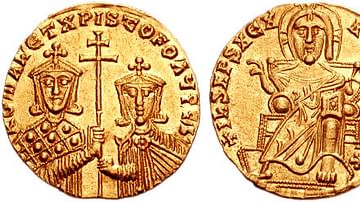
Romanos I
Romanos I Lekapenos (“the Ignorant”) was emperor of the Byzantine Empire from 920 to 944 CE. Of Armenian descent, he was a military commander who usurped the throne to rule as co-emperor with the rightful heir, but still minor, Constantine...
