
Search
Remove Ads
Advertisement
Search Results

Definition
Baal
Baal (also given as Ba'al) is a Canaanite-Phoenician god of fertility and weather, specifically rainstorms. The name was also used as a title, however, meaning "Lord" and was applied to a number of different deities throughout the ancient...

Definition
The Great Sphinx of Giza
The Great Sphinx of Giza is the most instantly recognizable statue associated with ancient Egypt and among the most famous in the world. The sculpture, of a recumbent lion with the head of an Egyptian king, was carved out...

Definition
Domitian
Domitian was Roman Emperor from 81 to 96 CE and his reign, although one of relative peace and stability, became engulfed in both fear and paranoia. His death at the hands of those who were closest to him brought an end to the short...
Definition
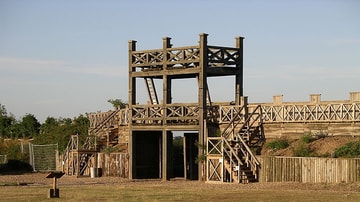
Roman Fort
The Roman army constructed both temporary and permanent forts and fortified military camps (castrum) across the frontiers of the empire's borders and within territories which required a permanent military presence to prevent indigenous...

Definition
Valerian
Valerian ruled as emperor of the Roman Empire from 253 CE until his capture in 260 CE. In 253 CE an elderly Roman military commander and experienced former senator was proclaimed emperor by his troops - a very common occurrence at the...

Definition
Ancient Egyptian Literature
Ancient Egyptian literature comprises a wide array of narrative and poetic forms including inscriptions on tombs, stele, obelisks, and temples; myths, stories, and legends; religious writings; philosophical works; wisdom...

Definition
Picts
The Picts were a people of northern Scotland who are defined as a "confederation of tribal units whose political motivations derived from a need to ally against common enemies" (McHardy, 176). They were not a single tribe, nor necessarily...

Definition
Tribune
Tribune was a title of various offices in ancient Rome, the two most important of which were the tribuni plebis and tribuni militum. The military tribunes were responsible for many administrative and logistics duties, and could lead...

Definition
Heraclius
Heraclius (Herakleios) was emperor of the Byzantine Empire from 610 to 641 CE. He crushed the Persian empire and returned the looted True Cross to Jerusalem, but the second half of his reign was beset by intrigues and ecclesiastical...

Definition
Great Pyramid of Giza
The Great Pyramid of Giza is a defining symbol of Egypt and the last of the ancient Seven Wonders of the World. It is located on the Giza plateau near the modern city of Cairo and was built over a twenty-year period during...
