
Search
Did you mean: Deir el-Medina?
Remove Ads
Advertisement
Search Results

Definition
Archaeology
Archaeology is a wide subject and definitions can vary, but broadly, it is the study of the culture and history of past peoples and their societies by uncovering and studying their material remains, i.e. tools, ruins, and pottery...
Definition
Phoenician Government
The governments of such Phoenician cities as Tyre, Sidon, and Byblos were led by hereditary monarchs throughout their history. Those individual cities typically acted autonomously from each other and only rarely did they form...

Definition
Hypatia of Alexandria
Hypatia of Alexandria (c. 370 - March 415) was a female philosopher and mathematician, born in Alexandria, Egypt possibly in 370 (although some scholars cite her birth as c. 350). Little is known of her life but her dramatic...

Definition
Phocion
Phocion (c. 402 – 318 BCE) was an Athenian statesman and military commander who, according to tradition, was made a general a staggering 45 times. A student of Plato and known as 'the Good', his political position was somewhat ambiguous...

Definition
Oppidum - The Hilltop Fort of the Celts
Celtic hilltop forts, often called oppida (sing. oppidum), after the Latin name given to larger settlements by the Romans, were built across Europe during the 2nd and 1st century BCE. Surrounded by a fortification...

Definition
Inca Warfare
The warfare of the Inca civilization was characterised by a high degree of mobility, large-scale engagements of hand-to-hand combat, and the establishment of a network of fortresses to protect an empire of over 10 million subjects...

Definition
Acropolis
An acropolis is any citadel or complex built on a high hill. The name derives from the Greek akro, "high" or "extreme/extremity" or "edge", and polis, "city", translated as "high city", "city on the edge" or "city in the air", the...
Definition
Pachacamac
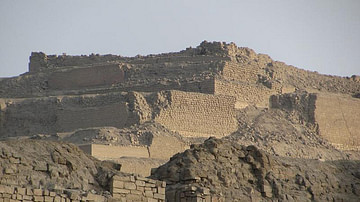
Pachacamac, located on the coast of Peru and 32 km south of Lima, was an important sacred site, oracle, and place of burial, which was visited by pilgrims of many ancient Andean cultures, including the Incas. The site, active for...

Definition
Xenophanes of Colophon
Xenophanes of Colophon (l. c. 570 to c. 478 BCE) was a Greek philosopher born 50 miles north of Miletus, a city famed for the birth of philosophy and home to the first Western philosopher, Thales of Miletus (l. c. 585 BCE...

Definition
Wars of the Diadochi
On June 10, 323 BCE Alexander the Great died in Babylon. Although historians have debated the exact cause most agree that the empire he built was left without adequate leadership for there was no clear successor or heir. The...
