
Search
Remove Ads
Advertisement
Search Results

Definition
Karnak
Karnak is the modern-day name for the ancient site of the Temple of Amun at Thebes, Egypt. The Egyptians called the site Nesut-Towi, "Throne of the Two Lands", Ipet-Iset, "The Finest of Seats" as well as Ipt-Swt, "Selected Spot" also given...

Definition
Astarte
Astarte is the Canaanite/Phoenician goddess of love, sex, war, and hunting who developed from the Mesopotamian deity Inanna/Ishtar. She is usually associated with the storm god Baal but seems to have been much more popular. She traveled to...

Definition
Third Intermediate Period of Egypt
The Third Intermediate Period (c. 1069-525 BCE) is the era following the New Kingdom of Egypt (c. 1570-c.1069 BCE) and preceding the Late Period (c.525-332 BCE). Egyptian history was divided into eras of 'kingdoms' and 'intermediate periods'...

Definition
Amarna
Amarna is the modern Arabic name for the site of the ancient Egyptian city of Akhetaten, capital of the country under the reign of Akhenaten (1353-1336 BCE). The site is officially known as Tell el-Amarna, so-named for the Beni Amran tribe...

Definition
Thebes (Egypt)
Thebes was the capital of Egypt during the period of the New Kingdom (c.1570-c.1069 BCE) and became an important center of worship of the god Amun (also known as Amon or Amen, a combination of the earlier gods Atum and Ra). Its sacred name...

Definition
Xois
Xois (as the Greeks called it) was a vast ancient city located on a marshy island in the center of the Nile Delta of Egypt, modern-day Sakha. It was founded c. 3414-3100 BCE and was continuously inhabited until the rise of Christianity c...
Image
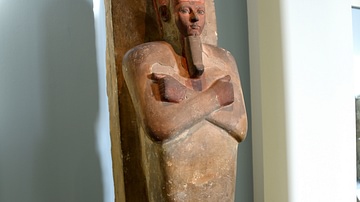
Osiride Statue of Amenhotep I
The King is shown in the pose, beard and robe of Osiris, the god of rebirth. This expressed a wish for eternal sed festivals: jubilees in which Amenhotep was to be rejuvenated. The King wears the double crown of Upper and Lower Egypt. Amenhotep's...

Article
Women in Ancient Egypt
Women in ancient Egypt were regarded as the equals of men in every aspect save that of occupation. The man was the head of the household and nation, but women ran the home and contributed to the stability of that nation as artisans, brewers...

Article
Cosmetics in the Ancient World
The wearing of cosmetics and perfumes by both men and women goes back a very long way indeed as the ancients were just as keen as anyone to improve their appearance as quickly and as easily as possible using all manner of powders, creams...
Article
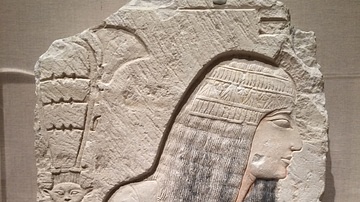
Women's Work in Ancient Egypt
Women in ancient Egypt had greater rights than in any other civilization of the time. They could own land, initiate divorce, own and operate their own business, become scribes, priests, seers, dentists, and doctors. Although men were dominant...
