
Search
Remove Ads
Advertisement
Search Results

Article
The Egyptian Amulet: Pious Symbols of Spiritual Life
Material Objects & Cultures Material objects convey volumes about the people who possessed them. Cultures and societies in every generation are in part classified - either correctly or incorrectly - by the objects or symbols they select...
Article
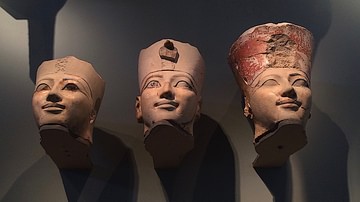
The Statuary of Maatkare Hatshepsut
One of the most fascinating aspects of the female pharaoh Maatkare Hatshepsut's reign (1479 - 1458 BCE) is the artwork she left behind. Art served an important purpose in Egyptian society; every statue, mural, and motif had a significant...

Article
The Five Gifts of Hathor: Gratitude in Ancient Egypt
The central cultural value of ancient Egypt was ma'at – harmony and balance – which maintained the order of the universe and the lives of the people. Keeping balance in one's life encouraged the same in one's family and, by extension outward...

Article
Balance & the Law in Ancient Egypt
Egyptian law was based on the central cultural value of ma'at (harmony and balance) which was the foundation for the entire civilization. Ma'at was established at the beginning of time by the gods when the earth and universe were formed...

Image
Temple of Hatshepsut, Aerial View
The Temple of Queen Hatshepsut of Egypt at Deir al-Bahri, Thebes, Egypt

Image
Hatshepsut
Detail of Hatshepsut, Eighteenth dynasty of Egypt, c. 1473-1458 B.C. Indurated limestone sculpture at the Metropolitan Museum of Art, New York City. Hatshepsut is depicted in the clothing of a male king though with a feminine form. Inscriptions...
Image
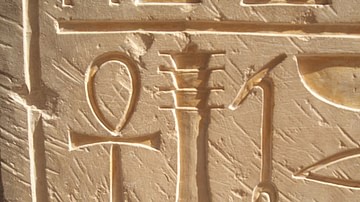
Ankh, Djed & Was
Relief showing an ankh (symbol of life), djed (symbol of stability), and was (symbol of power) from the tomb of Hatshepsut's mortuary temple at Deir al-Bahri, Egypt.
Image
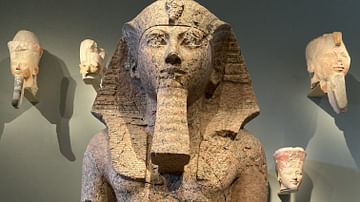
Kneeling Statue of Hatshepsut
This is a large, kneeling statue of Hatshepsut that was found during excavations of her temple at Deir el-Bahri. In this statue, Hatshepsut is depicted wearing the nemes headcloth, a false beard on her chin, andis kneeling with a nemset jar...

Image
Egyptian Afterlife
A wall-painting from the tomb of Sennedjem, an Egyptian craftsman, depicting the deceased and his wife Iyneferti blissfully harvesting their fields in the afterlife. Deir el-Medina, near Thebes, c. 1200 BCE.
Image
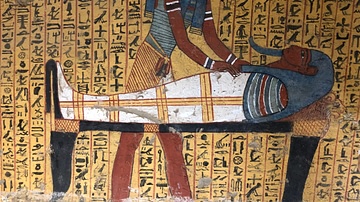
Anubis Tending to a Mummy
A relief depicting the god Anubis attending to the mummy of a worker, identified as either Amennakht or Nebenmaat. The relief, and the tomb it is in, date to the reign of Ramesses II (1279-1213 BCE). From the necropolis at Deir el-Medina...
