
Search
Did you mean: Circe?
Remove Ads
Advertisement
Search Results

Definition
Tutankhamun
Tutankhamun (also known as Tutankhamen and `King Tut', r. c.1336-c.1327 BCE) is the most famous and instantly recognizable Pharaoh in the modern world. His golden sarcophagus is now a symbol almost synonymous with Egypt. His name...

Article
Religion & Superstition in Colonial America
Religion and superstition went hand in hand in Colonial America, and one’s belief in the first confirmed the validity of the second. The colonists' worldview was completely informed by religion and so everything...

Article
Magic in Ancient Greece
For the Greeks magic (mageia or goeteia) was a wide-ranging topic which involved spells and evil prayers (epoidai), curse tablets (katadesmoi), enhancing drugs and deadly poisons (pharmaka), amulets (periapta) and powerful...
Article
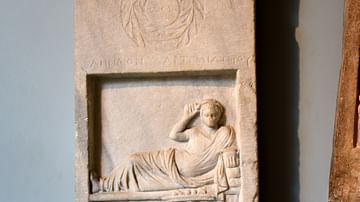
Curses & Fines on Epitaphs
The concept of a curse laid on a tomb or gravesite is best known from ancient Egypt but the practice was quite common in other civilizations of antiquity. The tomb or grave was the eternal home of the physical remains...

Definition
Naram-Sin - The God-King of Akkad
Naram-Sin (reign 2254-2218 BCE) was the last great king of the Akkadian Empire and the grandson of Sargon the Great (reign 2334-2279 BCE), who founded the empire. He is considered the most important Akkadian king...

Article
Truths Wrapped in Fiction: Mesopotamian Naru Literature - Originality in Writing Ancient Bestsellers
Originality in literary compositions in the ancient world did not carry the same weight and value as it does today. In recent centuries, authors have been applauded...

Article
Ten Ancient Egypt Facts You Need to Know - Fun Trivia About Ancient Egypt
Ancient Egypt is defined as the civilization that flourished in North Africa between circa 6000 and 30 BCE – from the Predynastic Period in Egypt (circa 6000 to circa 3150 BCE) through...

Definition
Melusine
Melusine (pronounced Mel-ew-seen, also given as Melusina) is a legendary figure from European folklore depicted as a mermaid, sometimes with two tails, as a serpent from the waist down, or as a dragon. She is associated with the ruling...

Definition
Seven Against Thebes
Seven Against Thebes is the third part of a trilogy written by one of the greatest of the Greek tragedians, Aeschylus in 467 BCE, winning first prize in competition at Dionysia. Unfortunately, only fragments of the first two...

Article
The Legend of Cutha - A How-To on the Proper Relationship with One's God
The Legend of Cutha (also known as the Cuthean Legend of Naram-Sin, Cutha Legend, and Kutha Legend) is a fictional work dated to the 17th century BCE belonging to the genre known as...
