
Search
Remove Ads
Advertisement
Search Results

Definition
Caligula - The First Mad Emperor of Rome
Caligula (12-41 CE) was the third Roman emperor, who reigned from 37 to 41 CE. A member of the Julio-Claudian Dynasty, he came to power after the death of his great-uncle Tiberius. The ancient sources claim...

Definition
Colosseum - Rome's Great Flavian Amphitheatre
The Colosseum or Flavian Amphitheatre is a large ellipsoid arena built in the first century CE by the Flavian Roman emperors of Vespasian (69-79 CE), Titus (79-81 CE) and Domitian (81-96 CE). The massive...

Definition
Seneca
Lucius Annaeus Seneca (Seneca the Younger, l. 4 BCE - 65 CE) was a Roman author, playwright, orator, and most importantly a tutor and advisor to the Roman emperor Nero (r. 54-68 CE). Influenced by Stoic philosophy, he wrote several philosophical...
Definition
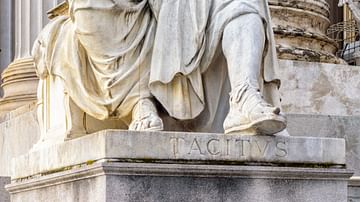
Tacitus
Publius Cornelius Tacitus (l. c. 56 - c. 118 CE) was a Roman historian, active throughout the reign of Trajan (r. 98-117 CE) and the early years of Hadrian (r. 117-138 CE). His best-known works are Histories and Annals, which cover the...

Definition
Aurelian
Aurelian was Roman emperor from 270 to 275 CE. He was one of the so-called Barracks Emperors, chosen by the Roman army during the turbulent period known as the Crisis of the Third Century (235-284 CE). Besides victories against various...

Definition
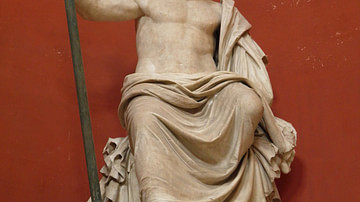
Germanicus
Germanicus (15 BCE - 19 CE) was a commander in the Roman Empire with a glowing reputation in his time under the rule of the Emperor Tiberius. His position in the Roman Empire was a unique and important one. His marriage to Agrippina...
Definition
Galba
Galba was Roman emperor from June 68 to January 69 CE. With the death of Emperor Nero on June 9, 68 CE, the Julio-Claudian dynasty officially ended, leaving the Roman Empire without a clear successor to the throne. With the assistance...

Definition
Ostia
Ostia (or Ostia Antica) lies 15 km from the city of Rome for which it served as the city's principal port and harbour throughout antiquity. The name derives from 'os' or 'ostium' which means 'mouth' and refers to the city's location at...

Article
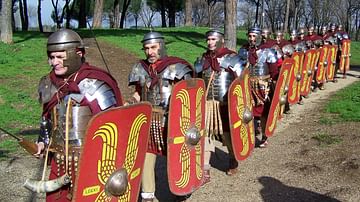
Enemies of Rome in the 3rd Century CE - The Greatest Enemy of Rome was Rome Itself
It has been said that the greatest enemy of Rome was Rome itself, and this is certainly true of the period known as the Crisis of the Third Century (also known as the Imperial...
Article
Legions of Moesia
The province of Moesia was vital to the Roman military’s protection of the Balkans. Subdued by the Roman commander Marcus Licinius Crassus in 29 BCE, it was initially part of Macedonia. Due to its location along the Danube, it...
