
Search
Remove Ads
Advertisement
Search Results

Definition
Albrecht Dürer
Albrecht Dürer (1471-1528) was a German Renaissance artist who is considered one of the greatest painters and engravers in history. A native of Nuremberg, Dürer was famous in his own lifetime at home and abroad for his oil paintings...

Definition
Abbasid Dynasty
The Abbasids were an Arabic dynasty that initially ruled over most of the Islamic empire (save some western parts) after assuming the caliphate in 750 CE, later on, their empire fragmented, however, they retained spiritual supremacy...

Article
Early Christianity
Emerging from a small sect of Judaism in the 1st century CE, early Christianity absorbed many of the shared religious, cultural, and intellectual traditions of the Greco-Roman world. In traditional histories of Western culture...

Article
Saladin & the Unification of the Muslim Front: 1169-1187 CE
Saladin (c. 1137 – 1193 CE), the Muslim ruler who crushed the mighty Crusader army at the Horns of Hattin (1187 CE) and re-took Jerusalem after 88 years of Crusader control, was born in a world...

Article
Sioux Ceremonial Pipe
The Sioux ceremonial pipe is a sacred object of the Sioux nation used in the seven sacred rites as well as other observances to connect the people with the Great Spirit (Wakan Tanka), Mother Earth, the spirit world, and each...

Article
Ancient Persian Gods, Heroes, and Creatures - The Complete List
The term 'mythology' comes from the Greek mythos (story-of-the-people) and logos (word or speech), meaning the spoken story of a people. Every civilization of the ancient world developed a...
Article
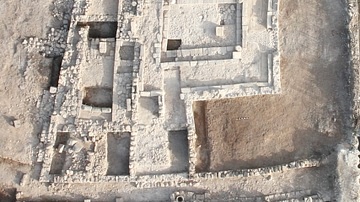
The Archaeological Excavations at Magdala
Magdala, known as Migdal in Hebrew (מִגְדָּל: tower) and also as Taricheae (Ταριχέα, from the Greek Τάριχος or tarichos: preserved by salting or drying fish), was an important fishing town during the first...

Article
Inanna and Su-kale-tuda - An Ancient Condemnation of the Crime of Rape
Inanna and Su-kale-tuda (circa 1800 BCE) is a Mesopotamian myth dealing with rape and justice in ancient Sumer. The work has been interpreted as an astral myth or a figurative account...

Definition
Manuel I Komnenos
Manuel I Komnenos was emperor of the Byzantine Empire from 1143 to 1180 CE. Manuel continued the ambitious campaigns of his grandfather Alexios I and father John II to aggressively expand the boundaries of his empire. Manuel...

Definition
Picts
The Picts were a people of northern Scotland who are defined as a "confederation of tribal units whose political motivations derived from a need to ally against common enemies" (McHardy, 176). They were not a single tribe, nor necessarily...
