
Search
Remove Ads
Advertisement
Search Results
Image
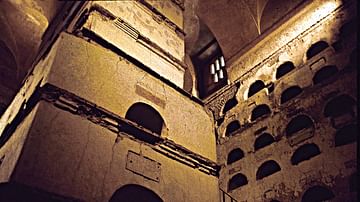
Columbarium 1 at Vigna Codini: Loculi & Central Pillar
Columbarium, excavated in 1840 CE, on strip of land between Via Latina and Via Appia.
Image
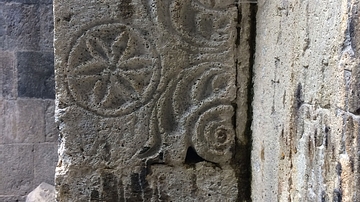
Artistic Decor in Arates Monastery in Central Armenia
The Arates Monastery in Armenia is built on top of a hill and overlooks the Arates tributary of the Yeghegis River. The monastery's name came from the combination of “ari” ("come" in Armenian) and “tes” ("see" in Armenian). It is likely that...

Image
Map of Europe After World War II (1945 to c. 1989)
In the aftermath of the Second World War (1939–1945), Europe emerged physically devastated and politically polarized. As Allied cooperation gave way to rivalry between the United States and the Soviet Union under Joseph Stalin (rule 1924–1953...

Image
Map of Europe after the Congress of Vienna, 1815
The Congress of Vienna (September 1814–June 1815) marked a decisive attempt by Europe’s great powers to reconstruct political order after more than two decades of revolutionary and Napoleonic warfare (1792–1815). Led principally by Austria...

Image
Map of Europe Before the Fall of Constantinople, c. 1450
Around 1450 CE, Europe and the Middle East were defined by fragmentation, declining medieval powers, and the rise of new regional states. The Byzantine Empire had contracted to Constantinople and a few outposts, while the Ottoman Empire under...

Image
Map of the Migration Period in Europe in the 4th-5th Century
The Migration Period in Europe (c. 4th–6th centuries CE) marks a prolonged era of movement, conflict, and political transformation rather than a single moment of collapse. Following the death of Emperor Theodosius I (reign 379–395 CE) and...

Definition
Batu Khan
Batu Khan (l. 1205-1255 CE) was a grandson of Genghis Khan and the founder of the Golden Horde. Batu was a skilled Mongol military commander and won battles from China to Persia, although his most famous exploits involve the grand Mongol...

Image
Europe after The Treaty of Versailles
This map illustrates the situation in Europe in November 1920 in the aftermath of First World War (1914-18), as the continent was reshaped by the Treaty of Versailles (1919) and the Treaty of Sèvres (1920). The German Empire had collapsed...

Image
Map of Europe after the Congress of Berlin, 1878 - From Italian and German Unification to Balkan Crisis
The mid-19th century transformation of Europe was driven above all by the unification of Italy and Germany, which reduced long-standing political fragmentation and introduced powerful new nation-states into an already competitive continental...

Image
The Feudal Society in Medieval Europe - Power in Medieval Europe: Lords, Land & the Church
The social structure of medieval Western Europe (c. 10th–13th centuries) is often described through the framework of feudal relationships and landholding systems that linked rulers, nobles, and rural communities. In this model, political...
