
Search
Remove Ads
Advertisement
Search Results

Article
Artillery in Medieval Europe
Artillery weapons in medieval Europe included the mounted crossbow (ballista) and single-arm torsion catapult (mangonel), both similar to ancient Roman machines. As armies battled further afield such as in the Byzantine Empire and against...

Image Gallery
Europe 1914–1949: History Maps of the World Wars
This map collection explores the geopolitical transformation of Europe between 1914 and 1949. From the First World War (1914-18) and the collapse of empires to the rise of fascism, communism, and totalitarian regimes, through the Second Wolrd...

Article
Siege Warfare in Medieval Europe
Siege tactics were a crucial part of medieval warfare, especially from the 11th century CE when castles became more widespread in Europe and sieges outnumbered pitched battles. Castles and fortified cities offered protection to both the local...

Definition
Romani
Romani is an umbrella term used to describe a diverse ethnolinguistic group of people with a historical presence in Europe and West Asia. The historically common term 'Gypsy' is based on the myth that they came from Egypt. In reality, the...

Image
Moon Idol from Central European Bronze Age
Clay figurine found in Chorvátsky Grob, Late Bronze Age. Slovak National Museum, Bratislava. Moon idols (Mondidole), also known as 'firedogs' (Feuerböcke), were clay figurines shaped like a dog or wolf, whose elongated, backward bending...

Image
Modern Map of Central America
A map of modern Central America.

Collection
The Celts of Ancient Europe
In this collection, we examine in detail the Celtic peoples of ancient Europe. We look at their origins in central Europe with the Hallstatt and La Tène cultures, the warfare and migration of the Celts, their society, art, religious beliefs...

Video
Medieval Europe - Religion In Medieval Europe
A concise presentation of the importance of religion in medieval Europe.
Image
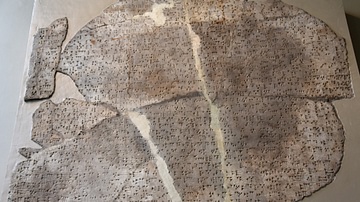
Door Slab from the Central Palace, Nimrud
These cuneifrom inscriptions describe some of the military campaigns of the Assyrian king Tiglath-pileser III (reigned 744-727 BCE) and were probably first placed in a doorway of the Central Palace built by this King at Nimrud. Assyrian...

Image
The Central Baths at Herculaneum
The Central Baths at Herculaneum were laid out around the beginning of the 1st century CE and were divided into separate (larger) men's and (smaller) women facilities, each with their sequence of changing room (apodyterium), warm room (tepidarium...
