
Search
Remove Ads
Advertisement
Search Results

Definition
Excalibur
Excalibur is the sword of King Arthur in Sir Thomas Malory's iconic work Le Morte D'Arthur published in in 1485 CE. The sword was originally introduced in Geoffrey of Monmouth's History of the Kings of Britain (1136 CE) as Caliburnus...
Image
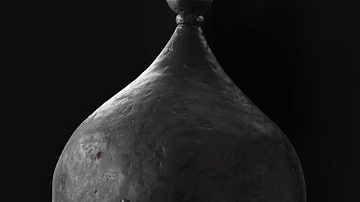
Celtic Helmet, 350 BCE
Helmet, iron, Giubiasco, Ticino. Around 350 BCE. Not just warriors: According to biased descriptions by the Romans and Greeks, the Celts were warriors and barbarians. However, finds of rich grave goods such as jewellery...
Image
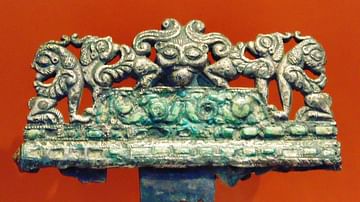
Celtic Belt Buckle
Celtic belt buckle, 5th century BCE.
Rheinisches Landesmuseum Trier, Germany.

Video
The Rise and Fall of the Celtic Warriors
Trace the rise and fall of the ancient Celts, a group of hundreds of independent warrior tribes defeated by the Roman Empire. — One summer evening in 335 BCE, Alexander the Great was resting by the Danube...
Image
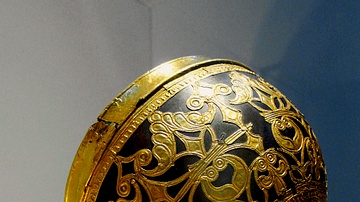
Celtic Bowl, Schwarzenbach Burial
A Celtic bowl with embossed gold leaf decoration from the princely burial at Schwarzenbach, Rhineland, Germany. 5th century BCE. (Staatliche Museen zu Berlin)

Image
Celtic Wine-Serving Vessels
Celtic vessels used for serving wine. Found in Waldalgesheim, western Germany. 330-320 BCE. (Rheinisches Landesmuseum, Bonn, Germany)

Image
Celtic Penannular Brooch
A Celtic penannular brooch from Burgos, Spain. Made prior to the 1st century CE (Iron Age). Made of a copper alloy. Diameter: 5 cm. (British Museum, London)

Image
Celtic Tripartite Vessel
A Celtic tripartite carinated pottery vessel. These vessels are made from three separate pieces, each with straight sides, which when assembled create an angular form. This example was found in a grave in the Marne region...
Image
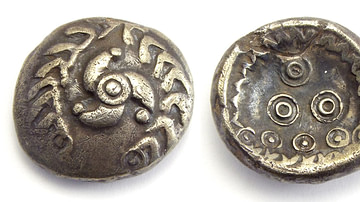
Celtic Regenbogenschüsselchen
An example of a Celtic coin known as a regenbogenschüsselchen of southern Germany and Bohemia. Electrum, 5th-1st century BCE.

Image
Celtic Brooch Given by Prince Albert to Queen Victoria
A silver and garnet Celtic brooch given by Albert, Prince Consort (1819-61) to Queen Victoria (reign 1837-1901) for Christmas 1849. (Royal Collection Trust)
