
Search
Remove Ads
Advertisement
Search Results

Article
Cosmetics, Perfume, & Hygiene in Ancient Egypt
For the ancient Egyptians life was a celebration, and so, just as one would want to look one's best at any party, personal hygiene was an important cultural value. The Egyptians bathed daily, shaved their...

Article
The History of Japanese Green Tea
The history of green tea in Japan goes back to the 8th century when it was a popular stimulant for meditating monks. In this article, we examine tea's origins and cultivation, how it became an integral part of Japanese...

Article
Queen Hatshepsut: Daughter of Amun, Pharaoh of Egypt
Hatshepsut, whose name means "Foremost of Noble Women" or "First Among Noble Women" (royal name, Ma'at-ka-re, translated as "spirit of harmony and truth") was the fifth ruler of the 18th Dynasty (r...
Image
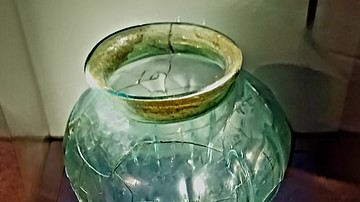
Roman Blue-Glass Cinerary Urn from Luguvalium
Roman blue-glass cinerary urn, from Luguvalium (Botchergate, Carlisle), 1st century CE. Carlisle Cathedral. Burning the body after death and keeping the bones and ashes in the cineraria (funerary urns...

Image
Stamped Pottery Jar from Tell al-Khulayfi
An oval seal impression repeated on the rim and handles of a large jar. Seal impressions are official guarantees of the jars and their contents; therefore, stamped jars indicated the presence of a local administrative...

Image
Mummified Lung of the Scribe Sutimose
This embalmed lung tissue was found in the canopic coffinette of the treasury scribe of the domain of Amun, Sutimose. Microscopic examination of a section of this tissue revealed an evidence that Sutimose had...

Article
Liangzhu Culture Jade
Jade artifacts and icons are almost synonymous with the Chinese culture going back thousands of years. Jade (nephrite) was first worked into recognizable objects c. 6000 BCE during the period of the Houli Culture (c. 6500...
Article
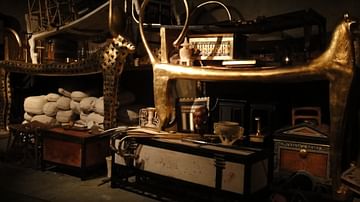
The Discovery of Tutankhamun's Tomb
Before Howard Carter discovered Tutankhamun's tomb, he began his career as a 17-year-old artist on an excavation in Egypt. His skills were soon recognized, and he quickly rose to be an excavator and later chief...

Article
The Five Gifts of Hathor: Gratitude in Ancient Egypt
The central cultural value of ancient Egypt was ma'at – harmony and balance – which maintained the order of the universe and the lives of the people. Keeping balance in one's life encouraged the same...

Article
Wine in the Ancient Mediterranean
Wine was the most popular manufactured drink in the ancient Mediterranean. With a rich mythology, everyday consumption, and important role in rituals wine would spread via the colonization process to regions all...
