
Search
Did you mean: Merlin?
Remove Ads
Advertisement
Search Results

Image
Pendant of Ishtar
On this rounded silver pendant, a woman worships the goddess Ishtar who stands on a lion. 9th to 7th century BCE. From Sam'al/Zincirli, modern-day Southern Turkey. (Pergamon Museum, Berlin)

Image
Block Statue of Harwa
Block statue of Harwa, chief steward of the God's Wife Amenirdis. Diorite. Third Intermediate Period, 25th Dynasty (Nubian Dynasty), c. 740 BCE, From Grave 37, Western Thebes, Egypt. (The Neues Museum, Berlin, Germany).

Image
Temple Relief of Amenhotep IV
On the right, the Egyptian pharaoh Amenhotep IV (r. 1353-1336 BCE later known as Akhenaten) raises his right arm and wears the blue crown of Egypt. Beside the right shoulder, his prenomen cartouche of "Neferkheperure"...

Image
Akhenaten & Nefertiti at a Feast
The royal couple, pharaoh Akhenaten (r. 1353-1336 BCE) and queen Nefertiti (c. 1370 - c. 1336 BCE), is seated at a feast, beneath the god Aten and under his rays. They are looking at each other and Nefertiti puts...

Image
Statue of Nefertiti
Limestone standing/striding figure of the Egyptian Queen Nefertiti (c. 1370 - c. 1336 BCE), the Great Royal Wife of Akhenaten (r. 1353-1336 BCE). New Kingdom, 18th Dynasty, c. 1345 BCE. From Amarna, Egypt. It is on display...
Image
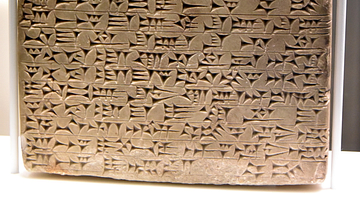
Foundation Inscription of Adad-nirari I
During the renovation work of the temple of Ishtar, the Assyrian king Tukulti-Ninurta I (r. 1243–1207 BCE) found a stone tablet among the foundations with an inscription by his grandfather Adad-nirari I (1295–1264...

Image
Male Mummy Mask from the Tomb of Aline
This is a mummy mask of Aline's husband. His right hand grasps what appears to be a wreath or garland of rose petals. His arms are wrapped in a toga. The eyebrows are painted (not made of glass) while the eyeballs...
Image
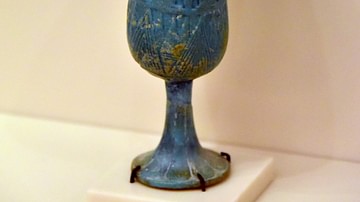
Faience Cup of Shoshenq
Faience cup of Shoshenq with a representation of different deities. From Saqqara, Egypt. Third Intermediate Period, 22nd (Libyan or Bubastite) Dynasty, 944-716 BCE. It is on display at the Neues Museum, Berlin, Germany.
Image
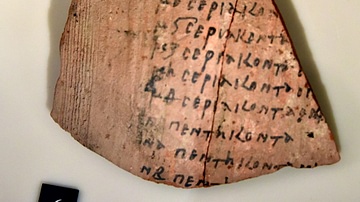
Ostracon with Mathematical Text
The Greek inscription on this fragment of ceramic (ostracon) mentions a list of exercises of numbers, from 83 to 52. The Greek numerals are compared with the numbered words. From Egypt, precise provenance is unknown...

Image
Statuette of a Woman from Naqada
Burned clay statuette of a woman standing in a vat. Probably from Naqada, Egypt. Naqada II (Gerzeh culture), c. 3600 BCE. (The Neues Museum, Berlin, Germany).
