
Search
Did you mean: Jainism?
Remove Ads
Advertisement
Search Results

Definition
Leonardo da Vinci
Leonardo da Vinci (1452-1519) was an Italian Renaissance artist, architect, engineer, and scientist. He is renowned for his ability to observe and capture nature, scientific phenomena, and human emotions in all media. Leonardo’s...

Definition
Horus
Horus is the name of a sky god in ancient Egyptian mythology which designates primarily two deities: Horus the Elder (or Horus the Great), the last born of the first five original gods, and Horus the Younger, the son of Osiris and Isis...

Definition
Doctrine of Discovery
The Doctrine of Discovery is a policy enacted initially by the 15th-century Catholic Church proclaiming the right of Christian nations to take possession of the lands of non-Christians in the interest of saving their souls...

Definition
Clovis I
Clovis I (or Chlodovech, 466-511/513 CE), king of the Franks, is considered the founding father of the Merovingian Dynasty, which would continue for over 200 years. Clovis became king at the age of 15, and by the time of his death 30...

Definition
Cathars
The Cathars (also known as Cathari from the Greek Katharoi for “pure ones”) were a dualist medieval religious sect of Southern France which flourished in the 12th century and challenged the authority of the Catholic Church. They were...
Definition
Rhea
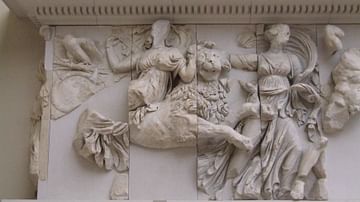
Rhea (also spelt Rheia) is a Titan and a mother goddess in Greek mythology. She is the daughter of Gaia (Earth) and Uranus (Heaven) and the mother of the great deities of Mount Olympus. Rhea was closely associated with the Phrygian (Anatolian...

Definition
Gnosticism
Gnosticism is the belief that human beings contain a piece of God (the highest good or a divine spark) within themselves, which has fallen from the immaterial world into the bodies of humans. All physical matter is subject to decay...

Definition
John Calvin
John Calvin (l. 1509-1564) was a French Reformer, pastor, and theologian considered among the greatest of the Protestant Reformation along with Martin Luther (l. 1483-1546) and Huldrych Zwingli (l. 1484-1531). Calvin synthesized the...

Definition
Augustine of Hippo
Aurelius Augustinus Hipponensis (354-430), better known as Augustine of Hippo, is extolled as the greatest of the Christian Church Fathers. More than any other writer, he developed what would become known as systematic theology...

Definition
Alfred the Great
Alfred the Great (r. 871-899) was the king of Wessex in Britain but came to be known as King of the Anglo-Saxons after his military victories over Viking adversaries and later successful negotiations with them. He is the best-known...
