
Search
Did you mean: Athena?
Remove Ads
Advertisement
Search Results

Article
Plato's Greater, Better World in The Last Days of Socrates
The Last Days of Socrates is a modern-day title for the collection of four Socratic dialogues by the Greek philosopher Plato – the Euthyphro, Apology, Crito, and Phaedo – telling the story of...

Article
A Visitor's Guide to Pompeii
Visitors to Naples and its surrounding area could be overwhelmed by the number of archaeological wonders to see. Buried for centuries beneath tons of volcanic ash and debris, the archaeological sites scattered along...

Article
Visitor’s Guide to the Monuments of Hadrian’s Villa
Hadrian’s Villa near Tivoli, Italy, is an opulent, sprawling garden-villa covering some 120 hectares (296 acres). It was built by Emperor Hadrian (76-138 CE) between 125-134 CE for use as his country...

Article
Cultural Links between India & the Greco-Roman World
Cyrus the Great (558-530 BCE) built the first universal empire, stretching from Greece to the Indus River. This was the famous Achaemenid Empire of Persia. An inscription at Naqsh-i-Rustam, the tomb...

Article
Agoge, the Spartan Education Program
The agoge was the ancient Spartan education program, which trained male youths in the art of war. The word means "raising" in the sense of raising livestock from youth toward a specific purpose. The program was...

Article
Pherenike the Female Olympic Trainer
Pherenike (l. c. 388 BCE, also known as Kallipateira) was an athlete from Rhodes who, because she was a woman, could not compete in the Olympic Games and, as a married woman, was not allowed to even watch them...

Article
The Economy of Ptolemaic Egypt
Ptolemaic Egypt rapidly established itself as an economic powerhouse of the ancient world at the end of the 4th century BCE. The wealth of Egypt was owed in large part to the unrivalled fertility of the Nile, which...
Article
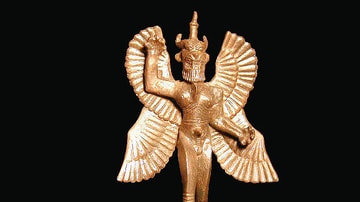
Twelve Menacing & Protective Mythological Figures
The term mythology comes from the Greek words mythos (“story of the people”) and logos (“word”) and so is defined as the spoken (later written) story of a culture. Modern scholars have divided myths...
Article
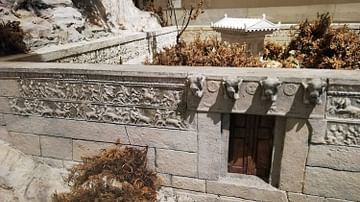
The Heroon of Trysa: A Lycian Tomb Reappears
The Heroon of Trysa was the tomb of a powerful Lycian dynast surrounded by a precinct wall covered with remarkable mythological friezes. It was discovered in 1841 CE when a Polish-Prussian school teacher...

Article
Curses & Fines on Epitaphs
The concept of a curse laid on a tomb or gravesite is best known from ancient Egypt but the practice was quite common in other civilizations of antiquity. The tomb or grave was the eternal home of the physical remains...
