
Search
Search Results

Article
The Siege of Acre, 1291 CE
The Siege of Acre in 1291 CE was the final fatal blow to Christian Crusader ambitions in the Holy Land. Acre had always been the most important Christian-held port in the Levant, but when it finally fell on 18 May 1291 CE to the armies of...

Collection
Warfare in Ancient China
Chinese warfare involved perhaps the largest and most technologically advanced armies in the ancient world. Chariots, cavalry, swords, bows and crossbows were all staple features of the battles which raged as rulers forever struggled to dominate...

Lesson Pack
Warfare & Battles in Ancient Greece
We have prepared four lesson plans including classroom activities, assignments, homework, and keys as well as: - Multiple choice quiz questions in an excel format. - Glossary of keywords and concepts in an excel format. - Open questions...

Definition
Vercingetorix
Vercingetorix (82-46 BCE) was a Gallic chieftain who rallied the tribes of Gaul (modern-day France) to repel the Roman invasion of Julius Caesar in 52 BCE. His name means "Victor of a Hundred Battles" and was not his birth name but a title...

Image Gallery
A Gallery of Neo-Assyrian Kings
The Neo-Assyrian kings are among the best-known of the Assyrian Empire and include Tiglath Pileser III, Shalmaneser III, Sargon II, Sennacherib, Esarhaddon, and Ashurbanipal. The term Neo-Assyrian is a modern-day designation; the Assyrians...

Definition
Library of Ashurbanipal
The Library of Ashurbanipal (7th century BCE) is the oldest known systematically organized library in the world, established in Nineveh by the Neo-Assyrian king Ashurbanipal (r. 668-627 BCE) to preserve the history and culture of Mesopotamia...

Definition
Tukulti-Ninurta I
Tukulti-Ninurta I (reigned 1244-1208 BCE) was a king of the Assyrian Empire during the period known as the Middle Empire. He was the son of Shalmaneser I (reigned 1274-1245 BCE) who had completed the work of his father, Adad Nirari I, in...

Article
Mesopotamian Effects on Israel During the Iron Age
The Iron Age in the traditional Ancient Near Eastern chronology ranges from somewhere around 1200 BCE to 333 BCE. It begins from the era when it was first thought iron came to be used up to the ascendency of Alexander the Great as the major...
Collection
Warfare in Classical Greece
The ancient Greek city-states were in a constant rivalry for land, resources and power which meant that warfare became an ever-present aspect of life. Athens and Sparta were famous rivals throughout the Classical period but other cities like...
Article
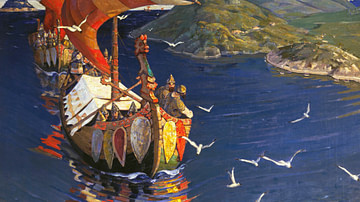
Trade & Warfare in the Kievan Rus
Scandinavians from the island of Gotland began to spread throughout the Baltic region along the Russian rivers in the 700s. While the Vikings of Norway and Denmark from the 8th to 11th centuries are widely recognized as fearsome raiders and...
