
Search
Search Results

Article
Chariots in Ancient Indian Warfare
The chariot was the elite arm of ancient Indian armies in the Vedic (1500 BCE – 1000 BCE) and Epic periods (described by the Ramayana and the Mahabharata, 1000-600 BCE) because of the advantages it conferred and the selection of plain ground...

Definition
Ashurbanipal
Ashurbanipal (r. 668-627 BCE, also known as Assurbanipal) was the last of the great kings of Assyria. His name means "the god Ashur is creator of an heir" and he was the son of King Esarhaddon of the Neo-Assyrian Empire. In the Hebrew Tanakh...
Article
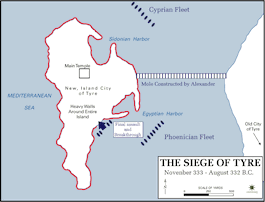
Alexander's Siege of Tyre, 332 BCE
After defeating Darius III at the battle of Issus in November 333 BCE, Alexander marched his army (about 35,000-40,000 strong) into Phoenicia, where he received the capitulation of Byblus and Sidon. Tyrian envoys met with Alexander whilst...

Article
Elephants in Greek & Roman Warfare
In the search for ever more impressive and lethal weapons to shock the enemy and bring total victory the armies of ancient Greece, Carthage, and even sometimes Rome turned to the elephant. Huge, exotic, and frightening the life out of an...
Article
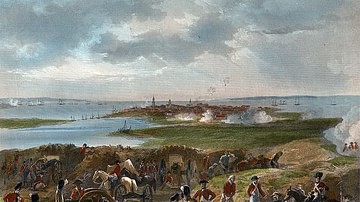
Siege of Charleston
The Siege of Charleston (29 March to 12 May 1780) was a major military operation during the American Revolutionary War (1775-1783). Hoping to establish a foothold in the American South, British commander-in-chief Sir Henry Clinton led an...

Definition
Siege of the Alamo - The "small affair" That Won Texas Independence
The Siege of the Alamo (23 February to 6 March 1836) was an engagement of Texian forces with the Mexican Army, leading up to the Battle of the Alamo on the morning of 6 March 1836. The 13-day siege and battle has become legendary and is among...

Lesson Pack
Mesopotamia: Empires & Warfare
This lesson pack on empires and warfare in ancient Mesopotamia includes the following content: Two Lesson Plans - Assyrian & Akkadian Empires - Mesopotamian Warfare Additional Materials - Open Questions / Essay Questions - Quiz...

Article
Fortifications in Ancient Chinese Warfare
While ancient Chinese warfare was often characterised by large armies in pitched battles, siege warfare and the sacking of cities were also regular features. Huge earth walls with towers and encircling ditches or moats became the normal strategy...

Definition
Sargon II
Sargon II (r. 722-705 BCE) was one of the most important kings of the Neo-Assyrian Empire as founder of the Sargonid Dynasty which would rule the empire for the next century until its fall. He was a great military leader, tactician, patron...

Article
Siege of Petersburg - Trench Warfare in the US Civil War
The Siege of Petersburg (June 1864 to April 1865), or the Richmond-Petersburg Campaign, was among the last military operations of the American Civil War (1861-1865). It was not a siege in the traditional sense, but rather a period of static...
