
Search
Remove Ads
Advertisement
Search Results

Article
Siege of Yorktown
The Siege of Yorktown (28 September to 19 October 1781) was the final major military operation of the American Revolutionary War (1775-1783). It resulted in the surrender of British general Lord Charles Cornwallis, whose army had been trapped...

Article
Siege of Toulon
The Siege of Toulon (29 August to 19 December 1793) was a decisive military operation during the French Revolutionary Wars (1792-1802), conducted by a French Republican army to retake the port city of Toulon from rebels, who were supported...

Definition
Assur
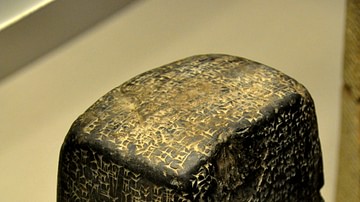
Assur (also Ashur, Anshar) is the god of the Assyrians who was elevated from a local deity of the city of Ashur to the supreme god of the Assyrian pantheon. His attributes were drawn from earlier Sumerian and Babylonian deities and so he...
Definition
Adad Nirari I
Adad Nirari I (r. 1307-1275 BCE) was the king of the Assyrian Empire who initiated the first major expansion of the Assyrian kingdom from the city of Ashur throughout the region of Mesopotamia. He also instituted what would become standard...

Article
Trench Warfare on WWI's Western Front
The trench warfare of the Western Front during the First World War (1914-18) involved soldiers living and dying in an awful mix of mud, filth, and barbed wire. Trench systems became more sophisticated in layout as the conflict dragged on...
Article
Elephants In Ancient Indian Warfare
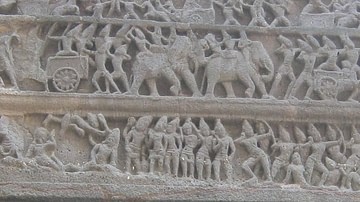
Elephants were used in the ancient Indian army, irrespective of regions, dynasties, or points in time; their importance was never denied and continued well into the medieval period as well. The ready availability in the subcontinent of the...

Article
Swords in Ancient Chinese Warfare
Although the bow and crossbow were the weapons of choice for much of China's history, the sword played its part, especially when warriors were forced to dismount and face the enemy at close quarters. Widely used from around 500 BCE, swords...
Image
Babylonian City under Assyrian Siege
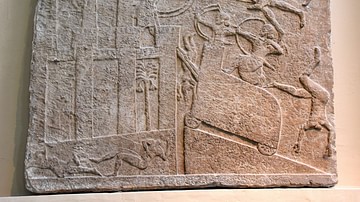
Assyrian relief showing a siege, from the Central Palace at Nimrud (ancient Kalhu), Mesopotamia, Iraq. Date palms indicate that the city, most of which was on an adjacent slab, was probably Babylonia. The Assyrians have built a siege ramp...
Image
Babylonia under Assyrian Siege
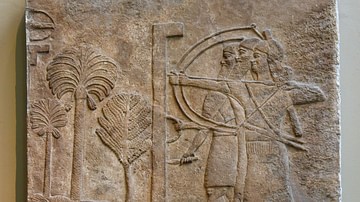
Assyrian relief, from the Central Palace at Nimrud (ancient Kalhu), Mesopotamia, Iraq, from the reign of Tiglath-Pileser III, c. 728 BCE. Date palms indicate that the city, most of which were on an adjacent slab, was probably Babylonia...

Article
Siege of Detroit
The Siege of Detroit (15-16 August 1812) was one of the first major actions of the War of 1812. After a botched invasion of Canada, a US army retreated to Fort Detroit, where it was besieged by British and Native American forces under Major...
