
Search
Remove Ads
Advertisement
Search Results

Article
Wall Reliefs: Apkallus of the North-West Palace at Nimrud
Religion is the sigh of the oppressed creature, the heart of a heartless world, and the soul of soulless conditions. It is the opium of the people. (Karl Marx, Critique of Hegel's Philosophy of...

Definition
Ashurbanipal
Ashurbanipal (r. 668-627 BCE, also known as Assurbanipal) was the last of the great kings of Assyria. His name means "the god Ashur is creator of an heir" and he was the son of King Esarhaddon of the Neo-Assyrian Empire. In the Hebrew...

Definition
Sargonid Dynasty
The Sargonid Dynasty was the last ruling house of the Neo-Assyrian Empire from 722-612 BCE, beginning with the reign of Sargon II and ending with fall of the Neo-Assyrian Empire. Some of the most famous kings in the history of...
Definition
Sargon II
Sargon II (r. 722-705 BCE) was one of the most important kings of the Neo-Assyrian Empire as founder of the Sargonid Dynasty which would rule the empire for the next century until its fall. He was a great military leader, tactician...

Definition
Tukulti-Ninurta I
Tukulti-Ninurta I (reigned 1244-1208 BCE) was a king of the Assyrian Empire during the period known as the Middle Empire. He was the son of Shalmaneser I (reigned 1274-1245 BCE) who had completed the work of his father, Adad...

Article
Achaemenid Kings List & Commentary
The Achaemenid Empire (c. 550-330 BCE) was the first great Persian political entity in Western and Central Asia which stretched, at its peak, from Asia Minor to the Indus Valley and Mesopotamia through Egypt. It...
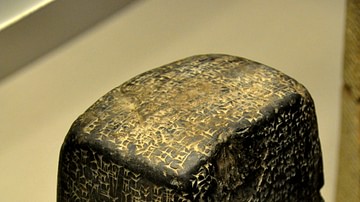
Definition
Adad Nirari I
Adad Nirari I (r. 1307-1275 BCE) was the king of the Assyrian Empire who initiated the first major expansion of the Assyrian kingdom from the city of Ashur throughout the region of Mesopotamia. He also instituted what would become...

Article
Sassanian Kings List & Commentary
The Sassanian Empire (224-651) was the greatest expression of Persian culture in the ancient world. It was consciously modeled on the earlier Achaemenid Empire (c. 550-330 BCE) which established Persian supremacy...
Definition
Ashur - The First Great Assyrian City
Ashur (also known as Assur) was an Assyrian city located on a plateau above the Tigris River in Mesopotamia (today known as Qal'at Sherqat, al-Shirqat District, northern Iraq). The city was an important center...

Definition
King David
According to biblical tradition (and some say myth), David (c. 1035-970 BCE) was the second king in the ancient United Kingdom of Israel who helped establish the eternal throne of God. A former shepherd, David was renowned for his...
