
Search
Remove Ads
Advertisement
Search Results

Article
Marcus Aurelius: Philosopher Emperor or Philosopher-King?
Co-authored by Steven Umbrello and Tina Forsee It is very common to hear in both academic circles, as well as more close-knit Stoic circles, Marcus Aurelius (121 – 180 CE) being referred to...

Article
Winning Against the Odds: Sargon II & the Urartu Campaign
It is often when one is faced with the most difficult circumstances that one is given the greatest opportunity for clarity. History provides ample evidence of this experience in showing how, when...

Definition
Henry II of England
Henry II of England ruled from 1154 to 1189 CE. He gained the throne by negotiation with his predecessor King Stephen of England (r. 1135-1154 CE) following the civil war that had raged between that monarch and Henry's mother...
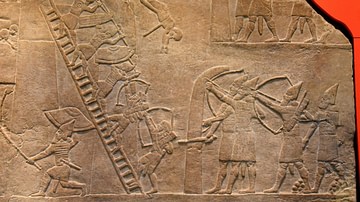
Image
Assyrian Archers Attacking an Egyptian Fortress at Memphis
Detail of a large gypsum wall panel showing the Assyrian army attacking the Egyptian city of Memphis and commemorating the final victory of the Assyrian king Ashurbanipal II over the Egyptian...

Image
Assyrian Soldiers Holding Decapitated Heads of Nubian Soldiers
Detail of a large gypsum wall panel, depicting the Assyrian attack on a fortress at the Egyptian city of Memphis in 667 BCE, Panel 17, Room M of the North Palace at Nineveh, Northern Mesopotamia...
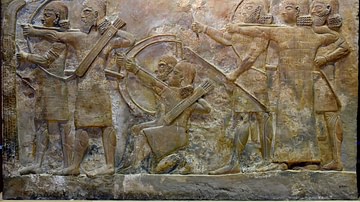
Image
Assyrian Archers from Khorsabad
Assyrian relief depicting a group of Assyrian archers attacking an enemy (not shown here), from the Royal Palace of Sargon II at Khorsabad, in modern-day Nineveh Governorate, Iraq, c. 710 BCE. A soldier holding a...

Definition
Ninurta - The Sumerian Hero-God of War
Ninurta (identified with Ningirsu, Pabilsag, and the biblical Nimrod) is the Sumerian and Akkadian hero-god of war, hunting, and the south wind. He first appears in texts in the early 3rd millennium BCE as an...

Definition
Charles I of England
Charles I of England (r. 1625-1649) was a Stuart king who, like his father James I of England (r. 1603-1625), viewed himself as a monarch with absolute power and a divine right to rule. His lack of compromise with Parliament...

Image
Assyrian Army Assault on Lachish
Assyrian relief, from the South-West palace at Nineveh (modern Kuyunjik, Mousil city, Iraq), room XXXVI, panel 7, Neo-Assyrian Empire, 700-692 BCE. This wall relief delivers a very vivid description of the battlefield...

Article
The Mesopotamian Pantheon - The Ancient Gods and Goddesses of the Near East
The gods of the Mesopotamian region were not uniform in name, power, provenance or status in the hierarchy. Mesopotamian culture varied from region to region and, because of this...
